
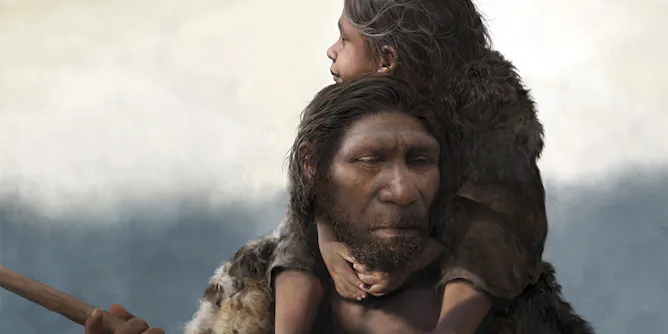
Ancient DNA from Neanderthal fossils in southern Siberia reveals a small community with close family ties – including a father and his teenage daughter.
Articles on Human history
Displaying 21 - 36 of 36 articles
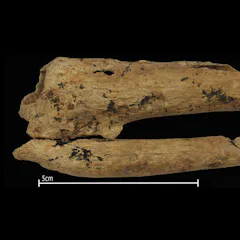
An astonishing discovery from the oldest known grave in Southeast Asia has revised medical history – the previous known amputation surgery was just 7,000 years ago.
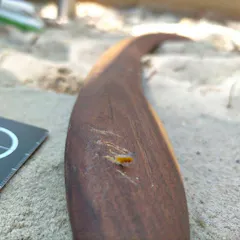
In a new study, archaeologists have re-discovered the role boomerangs played in retouching stone tools.

Stone-walled structures such as Driefontein often store information that’s not written down and are the only remaining resources to help understand local histories.
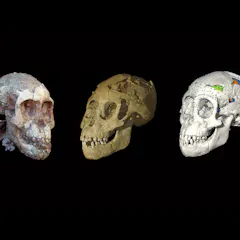
Our findings reveal the slowing down of brain development in our ape-like ancestors began more than three million years ago.
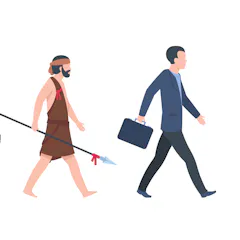
Understanding our evolution can tell us a lot about the health challenges we face today.
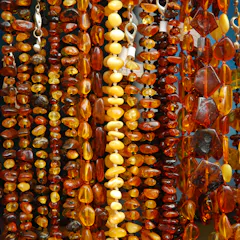
Archaeologists have uncovered a 2,000-year-old amber bead scam. But humans have been making fake jewels and icons for much longer than that.
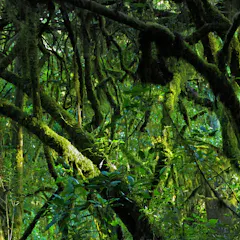
Rainforests may have played far more of a role in shaping human evolution than previously thought.
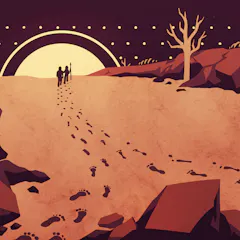
When did Australia’s human history begin?
The Conversation, CC BY16.6 MB (download)
Today's episode of Essays On Air, the audio version of our Friday essay series, seeks to move beyond the view of ancient Australia as a timeless and traditional foundation story.

From the tropics of Borneo, Darren Curnoe posted a daily diary sharing his team’s dig to explore ancient cemeteries. Through two metres of clay, human bones and tools were discovered.
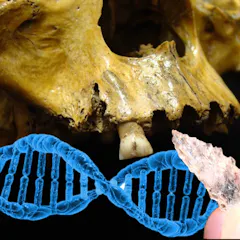
Archaeology is not only about stones and bones: it is mainly about the people of the past. DNA is one way to get from the stones and the bones to the people and their stories.
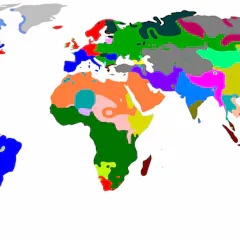
Evolutionary biologists ask very similar questions about species to those asked by linguists about languages.
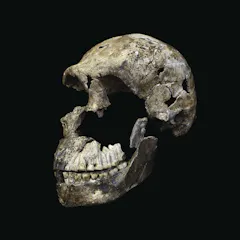
Evidence of Homo naledi’s age suggests we need to rethink our understanding of human history and evolution.
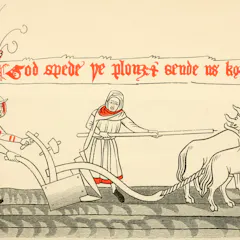
The environment minister recently told a conference that agriculture is as old as ‘mankind’. She’s out by a few million years.

Ask any anthropologist what they do and they will find it hard to give you a direct answer. But it ultimately comes down to studying people and their culture.
Humans evolved in Africa, spread across the world, and then it gets messy. Luckily advances in genetic sequencing have helped us track the complex history of human migration.
Top contributors
-

Mathematician and Ancient DNA Researcher, Adelaide University
-
Associate Professor of Archaeology, Griffith University
-
Professor in the Australian Research Centre for Human Evolution & Griffith Centre for Social and Cultural Research, Griffith University
-
Professor of Archaeological Science, Griffith University
-
Honorary Associate Professor, UNSW
-
Director, ARC Centre of Excellence for Australian Biodiversity and Heritage (CABAH), University of Wollongong
-
Professor of Archaeology, Griffith University
-
Director, Australian Research Centre for Human Evolution, Griffith University
-
Professor in Geochronology and Geochemistry, Southern Cross University
-
Sir John Monash Distinguished Professor, Monash University. Deputy Director ARC Centre of Excellence for Indigenous and Environmental Histories and Futures, Monash University
-
Lecturer, Deakin University
-
Principal Research Associate, UCL
-
Research fellow, Griffith University
-
Lecturer, School of Dentistry and Medical Sciences, Charles Sturt University
-
Professor with Research Focus in Stone Age Archaeology, Palaeo-Research Institute, University of Johannesburg