
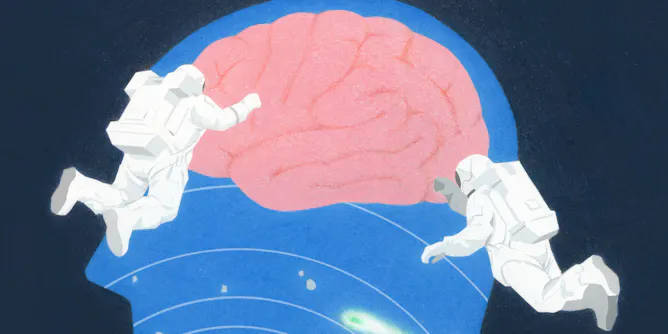
These changes aren’t permanent – the brain goes gradually back to normal after coming back to Earth. Understanding the physical effects of spaceflight helps plan space missions.
Articles on Human brain
Displaying 1 - 20 of 50 articles

How tasty is it? How healthy is it? Our brains work this out faster than conscious thought.
Science has done many things that seem miraculous. Why not transfer your consciousness to a machine?

The world’s largest genetic study on the size of specific brain parts has revealed hundreds of clues about how some health conditions develop.

Eight out of the 15 brains studied had microplastics in their olfactory bulbs.
Neuromorphic computers aim to one day replicate the amazing efficiency of the brain.

The human brain uses up 20% of the energy we consume.
The feasibility of mind uploading rests on three core assumptions. How plausible is each one, really?

Your brains can perceive some electromagnetic waves – but not without your body’s help.
There’s so much to process in our daily lives, we need habits to get us through and give the brain a break.
Your thoughts, emotions and behaviours arise from the complex network of electric activity in your brain. But what can we do when we need to tweak it?

The way human brains develop is special – but not quite as special as you’d like to think, if we consider Neanderthals as well.

Just months after the end of the second world war, the longest running study of health over the human life course in the world began – and it’s still going.

Socially isolated people have poorer cognition, including in memory and reaction time.
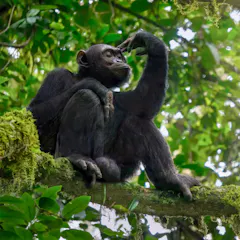
Human brains seem to be wired differently to those of chimps or macaques.

The claim that our brain size limits us to 150 meaningful friendships has been challenged by a recent paper.

Rather than distinctly male or female, the human brain is much more like the heart, kidneys and lungs – basically the same no matter the sex of the body it’s in.

Our biggest evolutionary advantages are an ability to walk on two legs and our big brains.

Where we would be without our brains? But think about it. How do they work?
Atheists may think more analytically than religious people, but it is far from proven.
Top contributors
-

Professor of Biomedical Engineering and Psychiatry, The University of Melbourne
-
Postdoctoral Research Fellow, Indiana University
-
Lecturer in Psychology, Arden University
-
Professor of Physiology and Biochemistry, University of South Wales
-
Postdoctoral Researcher in Cognitive Neuroscience, University of Pennsylvania
-
Postdoctoral Researcher in Cognitive Neurosciences, The University of Queensland
-
Assistant Professor of Communication Sciences, Case Western Reserve University
-
Professor Physiology, Endocrinology, Muséum national d’histoire naturelle (MNHN)
-
PhD Candidate in Neuroscience, UCL
-
Professor of Paleontology and Paleoecology, University of Naples Federico II
-
Assistant Professor of Habit Change, Bond University
-
Associate Professor in the School of Psychology, University of Birmingham
-
PostDoc fellow, Institute of Marine Sciences
-
Professor of Neurology, UCL
-
Senior Lecturer, School of Psychology and Centre for Human Brain Health, University of Birmingham