

As well as the added costs of upgrades and options that the marketing glosses over, people need to consider five other sources of cost blow-outs when building a home.
Articles on house construction
Displaying all articles

Current construction approaches are too slow to achieve the ambitious national housing target. But there’s a proven alternative building technology that’s more efficient, faster and greener.

Modular building techniques offer sustainable, affordable and adaptable solutions for a rapidly changing world.

An approach to building homes collectively, inspired by German baugruppen, has been adopted in Australia with positive results.
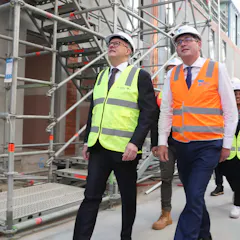
We can construct buildings that reduce atmospheric CO₂ by more than their lifetime emissions. They now don’t cost much more – and a project involving 1.2 million homes would drive costs down further.

Ageing brick apartment buildings of two to three storeys are being redeveloped in many suburbs. Typically, they are knocked down to be replaced by much bigger developments. But here’s an alternative.
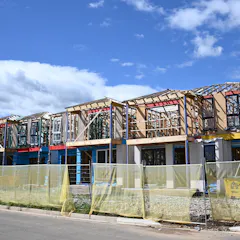
Targets of 50,000 new homes for rent at below-market rates and 1 million homes to improve affordability in general are positive steps, but the budget neglects the need to reform an ailing system.
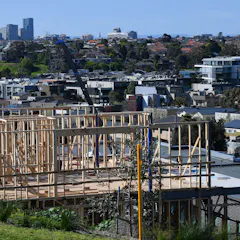
The pledge to build 30,000 homes over the next five years exposes the government’s inaction, but it’s still only a fraction of the number Australians need.
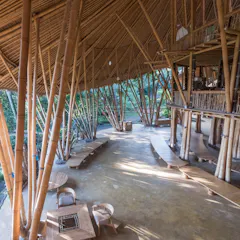
Bamboo has been used since ancient times for building, but only in recent decades has pioneering work in Bali inspired its wider use for substantial and enduring structures.

Years of regulatory failure are having direct impacts on the hip pockets of the many Australians who bought defective houses or apartments. It’s turning into a multibillion-dollar disaster.
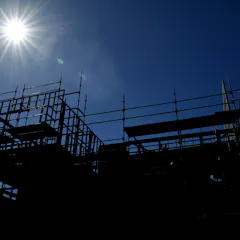
A tenfold increase in building is needed to overcome the current social housing shortfall and cover projected growth in need. But it can be done, and direct public investment is the cheapest way.
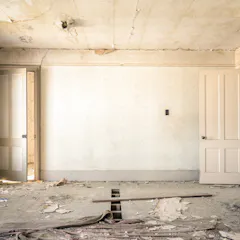
Renovations can create more waste than new constructions – but they don’t have to.
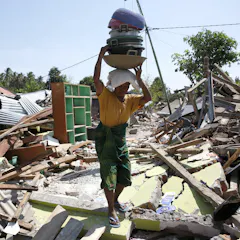
Hundreds of thousands of people are homeless following the Lombok earthquakes. Much of this suffering need not have happened if houses were constructed to better withstand shaking.
Top contributors
-

Emeritus Professor of Housing, UNSW
-
Lecturer in Architecture, Western Sydney University
-
Senior Research Fellow, Northern Institute, Charles Darwin University
-
Senior Lecturer in Social Anthropology, Te Kunenga ki Pūrehuroa – Massey University
-
Adjunct Professor, Centre for Urban Research, RMIT University
-
Senior Lecturer City Planning, UNSW
-
Senior Lecturer, School of Property, Construction and Project Management, RMIT University
-
Adjunct Professor of Architecture, University of Technology Sydney
-
Senior Lecturer, Director of The Master of Architecture, University of Technology Sydney
-
Director, ANU Institute for Climate, Energy & Disaster Solutions, Australian National University
-
Climate Program Manager, Institute of Climate, Energy and Disaster Solutions, Australian National University
-
Academic Fellow in Architectural Practice, University of Sydney
-
Associate Professor & Global Challenge Lead, Urban Transformations Research Centre, Western Sydney University; University of British Columbia
-
Senior Research Fellow, Institute for Climate, Energy and Disaster Solutions, Australian National University
-
Associate Professor in Marketing, Griffith University