
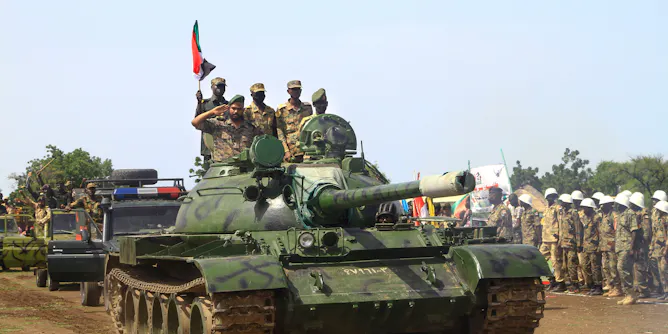
An expert on civil conflicts explains why the international community has so far failed to create peace in Sudan, and what new opportunities lie ahead.
Articles on Hemedti
Displaying 21 - 34 of 34 articles
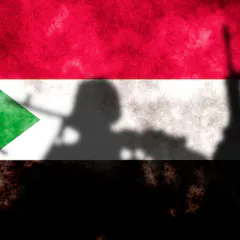
The Sudanese state today betrays its history as a plunder state on the margins of the global order.
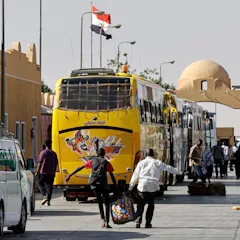
A spiralling Sudan will affect peace and security in the Lake Chad Basin region, of which Nigeria is a member.
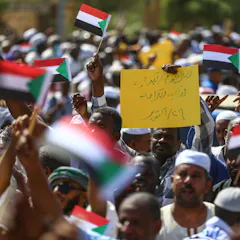
An African-led process would take into account complex regional dynamics – which would lead to a better and more stable peace agreement.
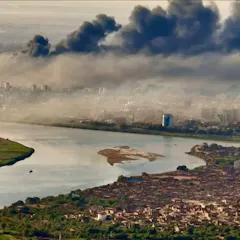
Both residents and Sudanese in the diaspora invested in homes to secure the future. Now the conflict is destroying hope.

The Sudan army’s superiority is in its air force and arsenal of ground forces while the rival paramilitary force relies on nimble mobile units.
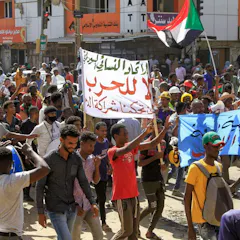
Sudan’s civilian protesters have gained a form of political power that traditional elites have struggled to attain.
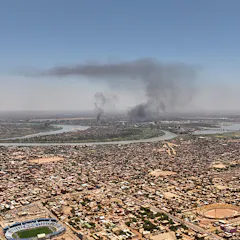
Sudan’s current conflict will have economic, social and political ripple effects across a number of countries
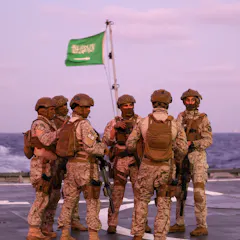
There is a risk that Sudan’s conflict could spill over into neighbouring countries.
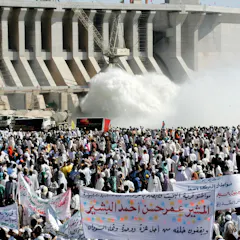
The Sudanese crisis is the culmination of three decades of contentious energy politics among rival elites.

Omar al-Bashir fell in 2019, but his military successors have preserved much of the authoritarian infrastructure of his regime.
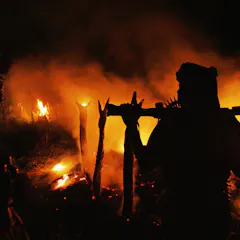
The Rapid Support Forces were created by former president Omar al Bashir to protect his regime from rebels - but they soon became a threat to both him and the future government.
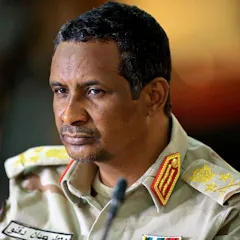
Hemedti ably used his commercial acumen and military prowess to build his militia into a force more powerful than the waning Sudanese state.
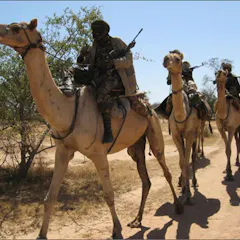
The Janjaweed militia first came into play when Omar al-Bashir’s government deployed it in Darfur
Top contributors
-

Professor, Weber State University
-
Senior Research Fellow and Program Leader for the Sudan Strategy Support Program, International Food Policy Research Institute (IFPRI)
-
Senior Researcher and Coordinator of the Small Arms Survey's Human Security Baseline Assessment project on Sudan and South Sudan, Graduate Institute – Institut de hautes études internationales et du développement (IHEID)
-
Research Fellow, International Food Policy Research Institute (IFPRI)
-
Professor of History, Colgate University
-
Researcher, Helwan University
-
Lecturer in Political Science, American University School of International Service
-
Senior Research Scholar at the Center on Global Energy Policy, Columbia University
-
Research Professor and Executive Director of the World Peace Foundation at The Fletcher School, Tufts University
-
Associate Professor of International Relations of the Middle East, University of Birmingham
-
Researcher and lecturer, City University of New York
-
Associate Professor of International Relations, University of Trieste
-
Adjunct Professor, Graduate School of Public and International Affairs, L’Université d’Ottawa/University of Ottawa
-
Director & SARChI Research Chair: Political Economy of Migration in the SADC Region, University of Pretoria
-
Professor, Zayed University