
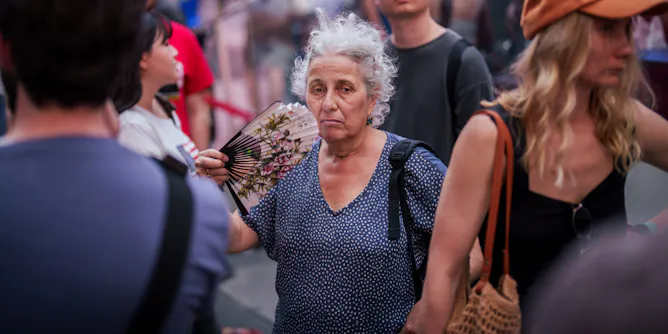
A public health researcher explains the signs to watch for that someone is developing heat exhaustion or heat stroke, and what to do.
Articles on heat-related illnesses
Displaying all articles

A public health researcher explains the signs someone is developing heat exhaustion or heat stroke, and what to do.

Heat-related deaths are increasing. People at greatest risk in extreme heat include older people, those with chronic conditions and those without air conditioning.

Here’s how to reduce heat-related health risks during major sporting events, from the Summer Olympics to test cricket. Athletes, officials, spectators and volunteers all need to take responsibility.

Many heat-related health problems can be avoided by adopting a healthy, active lifestyle. But the younger generation is less active than previous generations, and therefore more vulnerable.

Marginalised or minority groups seem to suffer the most from heat-related deaths and disease.

Summer heat may be far from people’s minds here in Australia. But Europe’s ordeal is yet another sign changes in Earth’s climate have already reached dangerous levels.

Unlike hurricanes, tornadoes and other weather phenomena, heat is a silent killer. The COVID-19 pandemic could make that worse.

Rising temperatures will not only hurt people in the future. Many are feeling the effects now. Those who work outdoors, those who have certain chronic conditions and the elderly are vulnerable.
Top contributors
-

Professor of Public Health, College of Charleston
-
Professor, University of the Witwatersrand
-
Medical scientist, National Institute for Communicable Diseases
-
Professor of Atmospheric Science, University of Leeds
-
Research Fellow, University of Leeds
-
Associate, Institute for Climate Change & Adaptation, University of Nairobi
-
Professor of Global Health and Environmental and Occupational Health Sciences, University of Washington
-
Associate Professor in Meteorology and Climate, University of Leeds
-
Assistant Professor, Aga Khan University
-
Associate Researcher, African Climate & Development Initiative and Climate System Analysis Group, University of Cape Town
-
Professor, Aga Khan University Hospital
-
Researcher, University of Cape Town
-
Professor of Epidemiology and Data Science, Tufts University
-
Professeur adjoint, Faculté des sciences de l'activité physique, Université de Sherbrooke
-
Professor of Public Health, James Cook University