
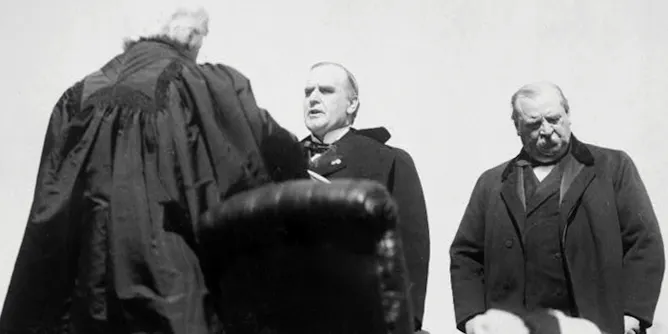
Two 19th-century elections are a reminder that a sizable midterm shift, like the one expected in November, can signal long-lasting changes in American politics that set the country in a new direction.
Articles on Gerrymandering
Displaying 1 - 20 of 72 articles

Florida’s population boom has fizzled to just 0.9% growth as domestic migration slows to a trickle.

From who gets to vote to how people travel and where taxpayer dollars are funneled, politicians and urban planners wield maps to control public imagination.

The Supreme Court has barred considering race when crafting legislative districts. But race could remain embedded in political gerrymandering, despite vehement claims to the contrary.

Florida voters don’t like Gov. DeSantis’ redistricting plans, but it doesn’t tend to be a vote-determining issue.

The electoral system used by many global democracies eliminates gerrymandering and has been shown to give more equal representation to minorities and women.

In dozens of states, an increasing number of legislative seats are going completely uncontested by one of the two major parties.
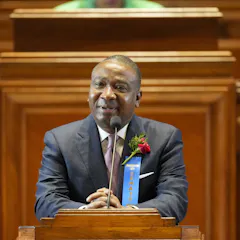
The Supreme Court appears poised to abolish a key part of the Voting Rights Act. It may draw on a constitutional amendment that empowered African Americans.

With a new, mid-cycle redistricting war raging in state after state, the media and politicians focus on which party is winning or losing seats. But are citizens winning or losing in this conflict?

As support for secessionist movements increases, it’s vital that political leaders reduce the divisions that threaten to tear the US apart.

With partisan advantage, clashing perceptions of reality and revolutionary readings of the Constitution all in play, the Supreme Court’s cases this year reach far into American politics and culture.

Gerrymandering has existed since the United States’ earliest days, but now technology and political trends are supercharging it.

The attempt by Texas Republicans to gerrymander more GOP legislative districts could backfire and deliver the party dummymandered districts. A political scientist explains the stakes.

Donald Trump’s return has normalised and supercharged authoritarianism internationally, making it the rule rather than the exception.

Surveys show Americans do not believe the political system is serving them. A mathematician of democracy highlights evidence-based changes that could improve matters without tearing the nation apart.

In two recent rulings, the conservative justices handed state lawmakers new power to redraw congressional maps to their liking – including in ways that end up diluting the Black vote.

One of Donald Trump’s favorite politicians is the Hungarian authoritarian leader Viktor Orbán. Would a country led again by Trump embrace similar antidemocratic politics?

Electoral redistricting is a high-stakes political game, so Democrats and Republicans have a hard time playing fair. When they’re made to work together, a more representative result is possible.

AI is likely to be used to help us run elections in the near future but there are risks as well as reward.

A battle over the voting districts in Detroit has landed in the Supreme Court, but any ruling may come too late for 2024 state elections.
Top contributors
-

Professor of Law, University of Richmond
-
Associate Professor of Political Science, Boise State University
-
Professor of American Civics, University of Tennessee
-
Associate Professor of Political Science, Binghamton University, State University of New York
-
Associate Professor of Political Science, College of Charleston
-
John Rennie Short is a Friend of The Conversation.
Professor Emeritus of Public Policy, University of Maryland, Baltimore County
-
Professor Emeritus of Political Science, Indiana University
-
Professor of Law, Wayne State University
-
Associate Professor of Political Science, University of Dayton
-
Professor of Political Science and Public Administration, Kutztown University of Pennsylvania
-
Professor of Political Science, Coastal Carolina University
-
Professor of Political Science, University of California, Irvine
-
Vice Provost for Graduate Studies and Dean of the Graduate Division, Professor of Education, University of California, Berkeley
-
Associate Professor of Mathematics and Senior Fellow of Tisch College of Civic Life, Tufts University
-
Managing Director of the McCourtney Institute of Democracy, Associate Research Professor, Political Science, Co-host of Democracy Works Podcast, Penn State