
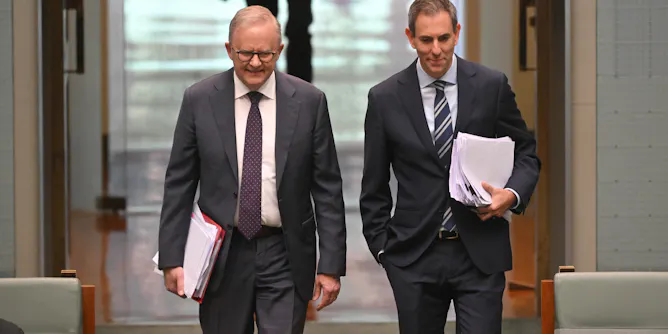
Governments in rich nations tend to spend more on health. Do we really want them to spend less?
Articles on Federal budget
Displaying 1 - 20 of 132 articles

The 2018 ‘reforms’ were bad policy. The sooner they are unwound the better.
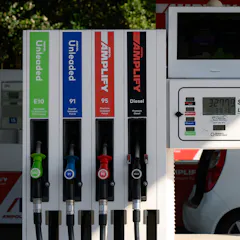
A more radical reform package would include a road user charge.
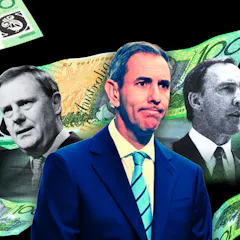
These four federal budgets brought in major reforms. This year’s effort is not quite so ambitious.

Long wait lists are the latest symptom of the aged care crisis. But this issue seems to be anything but a political priority.

The changes announced by the prime minister won’t help with supply and are poorly targeted.

In a time of economic uncertainty, just how bold will Jim Chalmers be? Or how bold will Anthony Albanese let him be?

The last cut in the fuel excise cost $5 billion. A temporary tax on gas exports could provide more targeted relief for households.

Rather than selling off land to private developers, the government has better options. A policy from the 1990s provides a guide.
Government spending – federal, state and local – grew by less than consumer spending and business investment last year.

Unfortunately, the way our government is structured can work against investments in better health prevention.
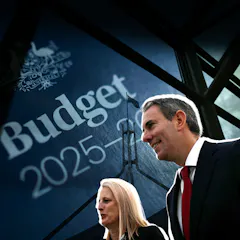
The drivers of the improvement are largely outside the government’s control. Meanwhile, total debt is projected to exceed $1 trillion for the first time by mid-2027.

The agency’s budget has grown steadily since the 1960s, fueling an industry that creates lifesaving medicines and attracts billions of dollars in investment.
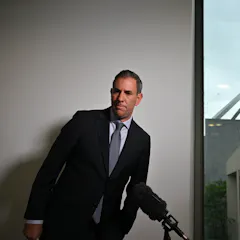
Inflation remains stuck above the Reserve Bank’s target band, as hopes for a rate cut fade.

How Ottawa responds through its fiscal strategy will determine whether Canada can navigate this new geopolitical and economic reality.

Budget 2025 failed to provide any measures to support and equip entrepreneurs and family business owners for generational transitions.

It’s one thing to abandon the dogmas of neoliberalism. It’s quite another to develop a coherent alternative.

While simply scrapping the 2018 deal might not be feasible, moving to an altogether new system could be a way forward.

Careful research into public information and in-depth interviews has shown the scale of personnel cuts at the Environmental Protection Agency.

Taxpayer-funded investment supports basic research that can yield crucial medical advancements down the line and make lifesaving drugs and technologies affordable for everyday people.
Top contributors
-

Professor of Economics, University of Canberra
-
Senior lecturer, Canberra School of Government, University of Canberra
-
Professorial Fellow, University of Canberra
-
Professiorial Fellow, The University of Melbourne
-
Daniel Patrick Moynihan Senior Lecturer in Public Policy and Public Finance, Harvard Kennedy School
-
Emeritus Professor of Economics (Griffith University) and Teaching Associate (University of Queensland), Griffith University
-
Professor, Centre of Policy Studies and the Impact Project, Victoria University
-
Professor, School of Economics, The University of Queensland
-
Deputy Director and Associate Professor, Centre of Policy Studies, Victoria University
-
Graduate Research Fellow of Sustainable Design and Construction, Stanford University
-
Adjunct Professor, Curtin Law School and Curtin Business School, Curtin University
-
Sr. Associate Vice President for Research and Research Professor, University of Oregon
-
Dean of Business School, University of Southern Queensland
-
Research fellow, Centre of Policy Studies, Victoria University
-
PhD Candidate, Global Projects Center, Stanford University