
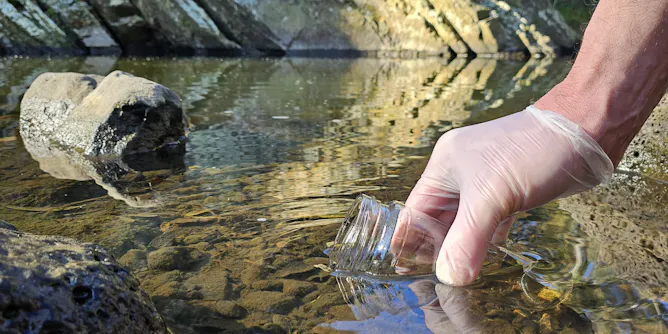
If you’re worried about pollution in the air we breathe, water we drink and food we eat, take time out to explore the evidence of harm and digest some practical advice on how to reduce your exposure.
Articles on Environmental pollutants
Displaying all articles

Herbicides and pesticides wash downriver from farms and towns – and some of these chemicals are taken up by oysters.

So-called ‘forever chemicals’ are in many of the everyday products we use.

In a new randomised clinical trial, we found regularly donating blood or plasma can reduce blood PFAS levels.

Warnings of an end to human sperm production have been making headlines recently, now with the added threat of shrinking penises. Is this science or sensationalism?
Like rings in tree trunks, the layers of our teeth carry a detailed record of our growth — and reveal lead contamination is common.

PFAS have been used in everything from coffee cups to frying pans. But they’re toxic, and accumulating in the environment.

South Africa’s rural communities where mining licenses have been granted are often excluded from consultations and bear the brunt having their environment and livelihoods destroyed.

Urban pollutants are a health concern in growing cities. Scientists are turning to honey bees to help monitor contaminants in soil, water, air and plants.

Brief exposure to a family of chemicals used as flame retardants early in life can permanently alter fat levels in the blood and liver, raising the risk of liver cancer and heart disease.
Most cases of breast cancer are related to environmental causes. When we talk about climate change, we must not forget this part of the story.

Water pollution, toxic chemical use and textile waste: fast fashion comes at a huge cost to the environment.
Once unleashed, glitter gets everywhere – not just in your house, but into the environment. Time to call a halt to the glitter explosion.

Australia needs stronger policy aimed at curbing air pollution, but the options currently on the table fall short. For now, we could all aim to drive less and turn off the engine when the car is idle.

The human body is a comprehensive, self-mending, self-detoxing apparatus that will perform its tasks regardless of whether you’re undertaking a rigid detox cure, or a gourmet food and wine marathon.
Top contributors
-

Professor and Associate Dean (Environment and Sustainability in Faculty of Science), The University of Melbourne
-
Ph.D., Sociology/Social Justice, University of Windsor
-
Professor in Forensic and Environmental Science, University of Staffordshire
-
Professor of Urban Transport and Public Health, The University of Melbourne
-
Reader in Fashion Marketing, Manchester Metropolitan University
-
Research & Teaching Academic, The University of Queensland
-
Clinical Research Manager, Macquarie University
-
Professor in the Australian Research Centre for Human Evolution & Griffith Centre for Social and Cultural Research, Griffith University
-
Professor Environmental and Marine Science, Southern Cross University
-
Assistant Professor of Environmental Health Sciences, UMass Amherst
-
Honorary Professor, School of Natural Sciences, Macquarie University
-
Senior Lecturer in Chemistry and Environmental Forensics, Manchester Metropolitan University
-
Research Manager, University of British Columbia
-
Senior lecturer in aquaculture, Pattimura University and doctoral student, Southern Cross University
-
Assistant Professor of Environmental Medicine and Public Health, Icahn School of Medicine at Mount Sinai