
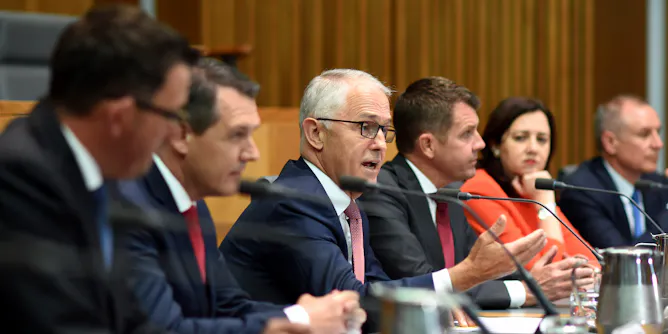
In the absence of strong federal action on climate change, many states have developed their own climate and energy policies.
Articles on Energy policy
Displaying 141 - 160 of 214 articles

From citizens who sit on the boards of energy companies to neighbourhoods that help fund local wind farms, community action is critical to the environmental movement.
An America that drills more, and imports less, could mean Opec no longer gets to call the shots.
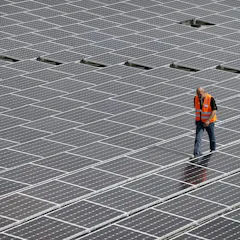
Renewable energy could be considered a central part of Malcolm Turnbull’s innovation ‘ideas boom’.

Nearly 5m tonnes of coal will soon be shipped through the Sundarbans each year.
The Australian Renewable Energy Agency is facing a $1.3 billion budget chop as part of the federal government’s savings measures. But sacrifice the lead agency for green energy development

The EU can’t be too tough on Erdogan as it relies on his nation’s pipelines and shipping routes.
A five point plan to give Britain an approach which tackles climate change while fostering growth.
There’s a wider trend towards linking the energy and climate portfolios, and not before time – the race is on towards a low-carbon economy, and joined-up policy gets faster results.
Australia’s energy policy has lost its way over the past couple of decades, which is unfortunate because the challenges – to move to a low-carbon economy without high prices – have never been tougher.
These countries are well-positioned to lead the way from fossil fuels to low-carbon energy.
Energy isolation would be more expensive and less secure.
Ghana could learn a great deal from Trinidad and Tobago about how to manage its energy sector – and about what pitfalls to avoid.
The U.S. coal industry is rapidly losing jobs and market share to lower-carbon energy sources. Here we examine what kind of aid can help mining communities transition to a post-coal future.
States and regions are taking the lead on climate change action and, so far, are seeing economic and environmental benefits.

It was a successful summit for Europe – at least on paper.
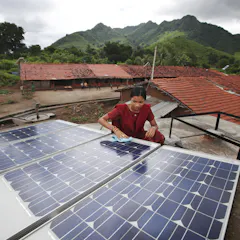
Developing countries need technical and financial aid to begin the transition to low-carbon energy now, not just pledges to invest in energy R&D with payoffs decades from now.
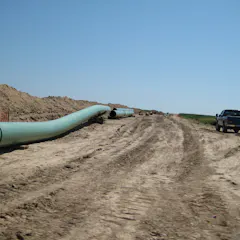
Obama will decide on the Keystone pipeline before he leaves office, but despite marginal voter interest, it’s an issue politicians on all sides will not let die.

When cold weather hits, heating costs can be a matter of life and death. So why are community groups the front line and not government?
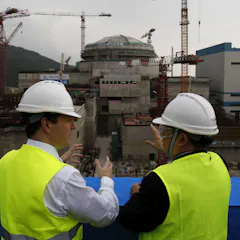
Is George Osborne deploying the ‘Deep State’ to secure a long-term nuclear arsenal for Britain?
Top contributors
-

Professorial Fellow, University of Canberra
-
Senior Industry Fellow, Environment and Planning, RMIT University
-
Senior Fellow in Energy and Climate Change, Grattan Institute
-
Senior Research Associate, University of Johannesburg
-
Honorary Associate Professor, Centre for Climate Economics and Policy, Australian National University
-
Senior Research Associate, Renewable Energy & Energy Systems Analyst, UNSW
-
Vice-Chancellor and President, University of Canberra
-
Departmental Visitor, Centre for Arab and Islamic Studies, Australian National University
-
Professor and Director, Victoria Energy Policy Centre, Victoria University
-
Lecturer in Energy Storage Systems Dynamics, Lancaster University
-
Energy Fellow, Grattan Institute
-
Democracy Deputy Program Director, Grattan Institute
-
Professor, Crawford School of Public Policy and Director, Centre for Climate and Energy Policy, Australian National University
-
Visiting Fellow, School of Global Studies, University of Sussex; University of Tartu; Utrecht University
-
Professor Emeritus, Macquarie Business School, Macquarie University