
Universities have seen a decade of cuts and unfavourable policies under the Coalition government. Here’s what the major parties should be promising now.
Articles on Demand driven system
Displaying 1 - 20 of 25 articles

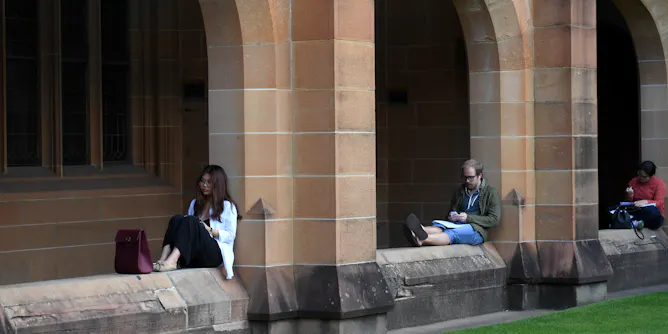
Many universities were built in the 1960s and 1970s and the government isn’t providing funds to maintain them.

If you’re confused about all the millions and billions thrown around for education by the two major parties, here’s the low-down on what the policies actually mean.

Labor’s main election promise for higher education is to restore the demand-driven system of funding, also known as scrapping the “cap” on government funding. Here’s why that would be a good policy.

If Labor is to once again uncap university funding, vocational education reform is a vital.

Discontinuing the demand driven system will mean less people are able to get a higher education, particularly groups of people who are already at a disadvantage.

One option could be to cut per-student funding and instead raise the student contribution from an average of about 40% to 50%, by raising HECS caps.

Demand for research grants has far exceeded supply, with success rates for grant applications falling to record lows.

The huge growth in student numbers is restricting the government’s capacity to increase levels of public funding per student and for research.

The main failure of university expansion is the unwillingness to fund it. Costs are certainly escalating, but priorities are always political as well as financial.

While on the face of it a 1.5% increase in the number of disadvantaged students going to university might seem minimal, in real terms this is genuinely significant.
Is Universities Australia right to say that new data shows that the growth in new university enrolments has flat-lined?

The latest Selected Higher Education Statistics have revealed an increase in student attrition, or the percentage of students commencing in 2013 who neither completed nor re-enrolled in 2014.

Knowledge for the sake of knowledge is important, but universities, as public institutions, have a responsibility to fulfil their public role too.

In recent years higher education enrolments have surged. This is triggering many policy issues including ballooning student debt.

Controversies surrounding university courses with low ATAR admission requirements have become a January ritual. Once universities make their offers to potential students, debates start over whether widening…

Since the removal of caps on how many people can attend university came into effect, enrolments at Australian universities have grown by close to 40%. Earlier this year the Group of Eight elite universities…
The 2013 student data has been released, which includes information on access for groups of students under-represented in higher education. Lately, most of the attention has been on students from low socio-economic…

In tackling the challenge of funding universities, we constantly confront a particular conundrum. Universities are hybrid organisations, straddling the public and private spheres. We are creatures of (mainly…
Late last year, education minister Christopher Pyne announced a review of Australia’s demand-driven system (DDS) of higher education. Pyne wants to know if it is: Increasing participation (particularly…
Top contributors
-

Professor of Higher Education Policy, Monash University
-
Senior Research Fellow, Curtin University
-
Adjunct Professor, Department of Leadership, Higher and Adult Education, OISE, University of Toronto
-
Vice-Chancellor, University of Newcastle
-
Vice-Chancellor, Queensland University of Technology
-
Executive Director, Student Equity; and Director, Centre for Higher Education Equity and Diversity Research, La Trobe University
-
Head of Corporate and Government Affairs, Swinburne University of Technology
-
Professor of International Higher Education, UCL
-
Principal policy adviser, Queensland University of Technology
-
Research Fellow at the National Centre for Student Equity in Higher Education, Curtin University
-
Chief Data Officer, University of the Sunshine Coast
-
Associate Professor, Melbourne Centre for the Study of Higher Education, The University of Melbourne
-
Vice Chancellor, Victoria University
-
Victoria University
-
President & Provost, UCL