
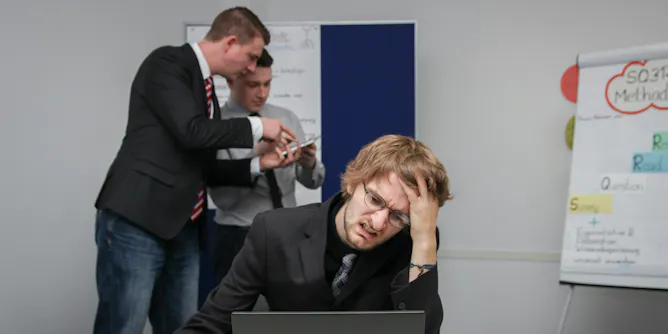
Gen Z workers don’t communicate better or worse than previous generations, but they learned to do so under very different circumstances.
Articles on Communication skills
Displaying 1 - 20 of 23 articles

The children most often left out of autism research may finally have a treatment worth testing.
In the early 2000s, we tested a new curriculum on more than 200 students. Here’s what we found when we met the students again, two decades later.

Engaging in purposeful, meaningful and strategic conversations with children can directly support children’s language comprehension, an important component of reading.

Aphasia is loss of language following brain damage. Conversation partners can help them say what they want to say.

We live in a world of spoken, visual and written communication, but the third mode continues to dominate teaching and assessment in university communication courses.

A survey of over a thousand scientists reveals that their goal when communicating about their work is to help the rest of us make evidence-based decisions that draw on scientific findings.

Communities prepare better for flood disasters when they have been actively involved in communicating information.

A scholar of how leaders communicate offers five key traits CEOs should use when communicating with their workers about coronavirus.

What international families can teach the rest of us about sustaining long-distance relationships.

Evidence for the benefits of empathy in healthcare is mounting.

Connecting with an audience in a productive way can mean first figuring out what they think, feel and believe before you start sharing your message.

In their relentless pursuit of research commercialization, and bigger robots, universities might miss the real opportunity of technology - to make our world a better place.

Despite the hype about STEM skills, research shows interpersonal, problem-solving and entrepreneurial skills will make you more employable in the 21st century.

Scientists who engage with the public may have goals about influencing policy or behavior. But they also need to think about the short-term objectives that will help get them there.

If you’ve only ever paired the idea of ‘rhetoric’ with ‘empty,’ think again. Rhetoricians of science have concrete techniques to share with researchers to help them communicate their scientific work.

The research community tends to assume advocacy doesn’t mix with objectivity. One study suggests there’s room for scientists to make real-world recommendations without compromising their trusted status.
When they start life, clichés are fetching and memorable phrases. But overuse has sucked them of vitality – and now they walk among the living dead.

Quirks of human psychology can pose problems for science communicators trying to cover controversial topics. Recognizing what cognitive science knows about how we deal with new information could help.

Now that we’re in a post-truth world, a timely report from the National Academies of Sciences, Engineering and Medicine highlights evidence for what works and what doesn’t when talking about science.
Top contributors
-

Professor of Public Relations, Michigan State University
-
Associate Professor of Advertising and Public Relations, The University of Texas at Austin
-
Assistant Professor of Public Relations, Northern Illinois University
-
Adjunct Research Professor, Department of History, Carleton University
-
Professor of Social Psychology, University of California, Los Angeles
-
Ph.D. Candidate in Cognitive Science, University of California, San Diego
-
Principal Research Scientist, CSIRO
-
Professor of Advanced Technology Transitions, Arizona State University
-
Associate Professor of Psychology, University of Georgia
-
Economist, Data61, CSIRO
-
Professor of Psychology, University of California, Los Angeles
-
Deputy Director, The Kids Research Institute Australia, Professor of Autism Research, The University of Western Australia
-
Professor of Communication, University of Washington
-
Associate Professor of Developmental Psychology, La Trobe University
-
Professor of Linguistics, Monash University