
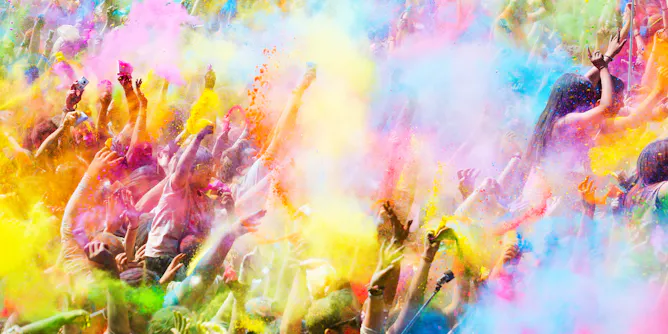
Indigo, pink, saffron: colour for India isn’t just for throwing. It’s political, too.
Articles on Colours
Displaying 61 - 75 of 75 articles

The pink ball introduced to this year’s day night cricket test can be difficult to see for some players, especially if they are colour blind. There is a better choice of colour.
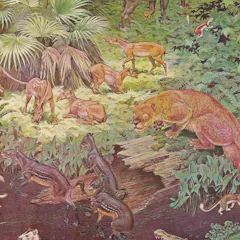
Scientists have shown how tiny organic tissue remnants in fossils correspond to the pigments in the animals’ original skin and hair.

The 13th century polymath Robert Grosseteste was ahead of his time when it came to understanding light, colour and the universe itself.
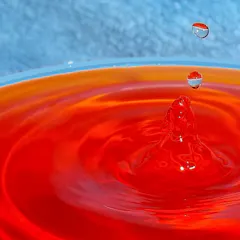
In a typical kitchen or bathroom you often find the hot and cold water taps labelled red and blue. It’s common practice in industrial and interior design in many parts of the world to present information…
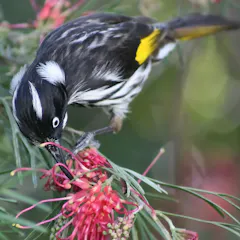
In Australia, honeyeaters are far and away the most abundant and important nectar-feeding birds, so also the most important avian pollinators of flowers. What effect has their visual perception had on…
Colour blindness tests on shrimp have quashed assumptions that more complex eyes mean better colour vision. Scientists found…
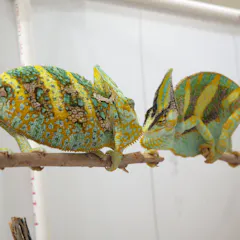
Humans have been fascinated by the colour-changing abilities of chameleons for a long time. Aristotle himself, the forefather of Western philosophy and also a keen zoologist, mentioned the lizard’s ability…
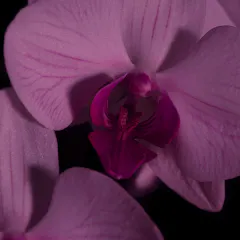
US colour swatch giant Pantone has picked a soft, rosy purple by the name of Radiant Orchid as the colour of 2014, displacing their 2013 choice, Emerald Green. According to Pantone marketing-speak the…
New links have been found between the colour patterns in a monkey’s face and its social structure and environment. Research…
Australian native flowers have moved away from insects as pollinators and instead coloured themselves to attract birds. Over…
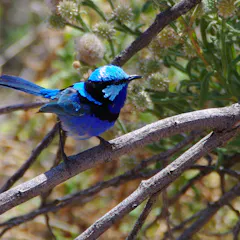
Why are some animals blue and others red? Explaining the diversity of colours in nature is a central issue in evolutionary biology. And part of the answer may lie in the most obvious place: the eye. In…
Vibrant blue plumage of breeding male fairy-wren may be linked to their higher visual sensitivity to ultraviolet (UV) light…
Iridescent surfaces such as opals, beetle exoskeletons and butterfly wings have unique colour properties due to their microscopic…
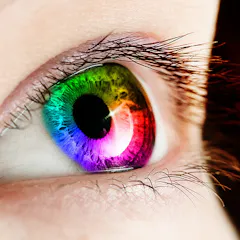
For more than 200 years, scientists have known the range of colours we can see means there must be three different types of light-responsive cells in our eyes. These three types of cell, along with the…
Top contributors
-

Associate Professor, Department of Physiology, Monash University
-
Professor of Psychology, Edge Hill University
-
Professor in High Medieval History, Durham University
-
Professor, School of Psychology, The University of Queensland
-
Professor of Natural Philosophy in the Department of Physics, University of York
-
Lecturer in Museum Studies, University of Leicester
-
Senior Lecturer in Fine Art, UCL
-
Reader in Polymers ad Nanomaterials, School of Pharmacy and Biomedical Sciences, University of Lancashire
-
Postdoctoral Researcher in Evolutionary Biology, Université de Lausanne
-
Senior Lecturer in the School of Psychology, University of Lincoln
-
Lecturer in Language, Cognition and Neuroscience, Lancaster University
-
Professeur, Chercheur Ornitologue, Université de Lausanne
-
Research fellow, Geology and Geophysics, University of Oslo
-
Senior Investigator at the National Eye Institute, Section on Perception, Cognition, and Action, National Institutes of Health
-
Professor, Palaeobiology, University College Cork