
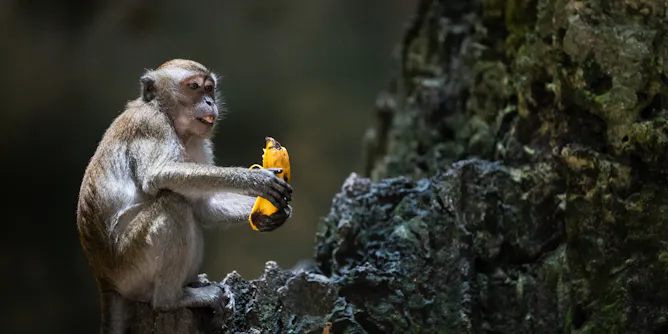
New fossil studies tell us our ancient ancestors enjoyed a diet of soft, sweet fruits. This would have influenced where they lived and spread to – and even the evolution of colour vision.
Articles on Colour vision
Displaying all articles
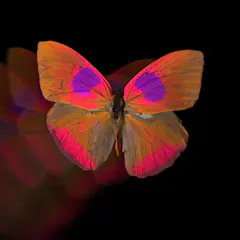
Humans can’t see ultraviolet light – but lots of other animals can.
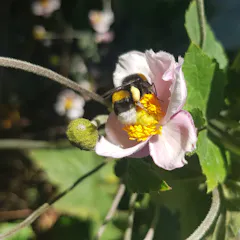
Bees can perceive flower colours and hues which are invisible to us — such as those produced by reflected ultraviolet radiation.

Rather than trying to out-compete each other, flowers may work together to attract bees en masse. It’s the sort of approach that is effective in the world of advertising too.

New research shows pink cricket balls can be extra difficult to see in those crucial minutes when day turns to night during play.

The pink ball introduced to this year’s day night cricket test can be difficult to see for some players, especially if they are colour blind. There is a better choice of colour.

The recent shark attack was enough to convince Australian surfer Mick Fanning that the colour of his surfboard may have been a factor. But what do sharks actually see in the water?
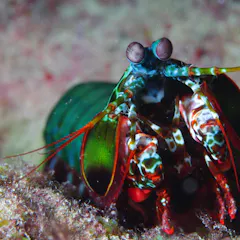
As humans, we live in a colourful world, but differences in visual systems means that not all animals see the world in the same way. Unlike other aspects of an object such as size or mass, colour is not…
Top contributors
-

Associate Professor, Department of Physiology, Monash University
-
Professor, School of Psychology, The University of Queensland
-
Curator of the Duke Lemur Center Museum of Natural History, Duke University
-
Research Fellow in Ecology and Evolution, University of Sussex
-
Assistant Professor, George Mason University
-
Professor of Comparative Neurophysiology, Macquarie University
-
Researcher and analyst, Monash University
-
Senior Lecturer in Oral Biology, University of Otago
-
Research Fellow in Biological Anthropology, Monash University
-
Postdoctoral Researcher, University of the Aegean
-
Associate Professor, Centre for Ecology and Conservation, University of Exeter