
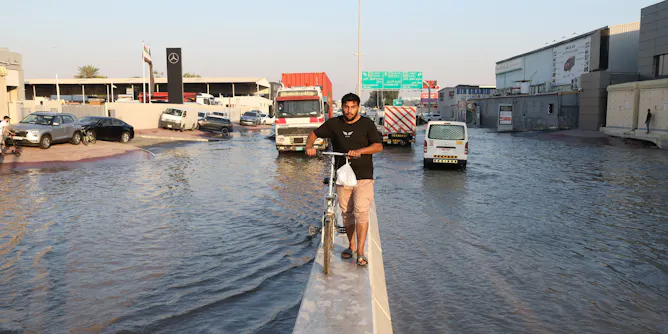
Hint: it’s not cloud seeding.
Articles on Cloud seeding
Displaying all articles
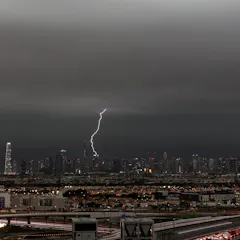
Some parts of the Gulf experienced 18 months of rain in a single day.
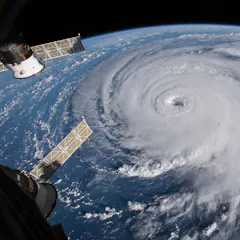
It may soon be possible to reduce cyclone formation and intensity by spraying particles into the atmosphere above a forming storm. But the technology opens up a can of worms
Cloud seeding – spraying materials into clouds to increase precipitation – has been around for nearly 80 years. But only recently have scientists been able to measure how effective it really is.
Several states are experimenting with weather modification to try to generate snow as water supplies shrink. An atmospheric scientist explains the history behind it – and the challenges.

Love it or hate it, winter means snow and ice for much of the US. In many places, though, snow is becoming a scarce resource.
Clouds formed by rising warm air currents are called ‘convection clouds’. Because of all the rising air coming up, these clouds can be bumpy on top, sometimes looking like cotton wool or cauliflower.
Governments and private companies have been seeding clouds to create snow for decades, without proof that it actually works. A recent study peered into clouds in search of answers.

We have the technology to temporarily shift wet weather elsewhere.

It’s a daunting technical challenge. But the key question is whether such engineering is socially acceptable.
Research coming from UCLA and five other universities has proven that by far the most effective way to prevent further global…
Shooting lasers into the air can trigger the formation of water droplets, a technique that could be used to help stimulate…
Top contributors
-

Assistant Professor of Atmospheric Science, University of Wyoming
-
Project Scientist, University Corporation for Atmospheric Research
-
Professor of Volcanoes and Climate, University of Bristol
-
James Martin Fellow, Oxford Martin School, Environmental Change Institute and Institute for Science Innovation and Society, University of Oxford
-
Hydrologist, Flood Forecaster, Australian Bureau of Meteorology
-
PhD Scholar in Climate Governance, Australian National University
-
Science + Technology Editor, The Conversation
-
Professor of Climate Science, University of Oxford
-
Head, Disaster Solutions, Australian National University
-
Professor Emeritus of Meteorology, Colorado State University
-
Founder and CTO of HelmGuard AI, Australian National University
-
Professor of Civil Infrastructure And Environmental Engineering, Khalifa University
-
Research Scientist in Agribusiness and Applied Economics, North Dakota State University
-
Director, ANU Institute for Climate, Energy & Disaster Solutions, Australian National University
-
Associate Science Editor & Co-Host of The Conversation Weekly Podcast, The Conversation