
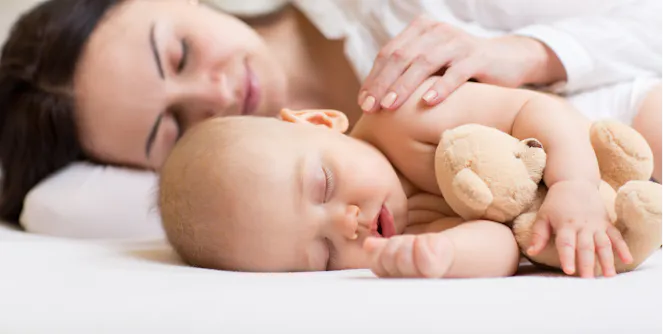
Questions about co-sleeping are often drowned out in a whirlwind of information and opinions. But science can provide some answers.
Articles on Children and sleep
Displaying 1 - 20 of 24 articles

A few one-off late nights and sleep-ins won’t hurt, but it’s best not to fall completely off the bedtime routine wagon during the holidays.

Sound sleep, for long enough every night, with consistent bed and wake-up times are critical for kids’ health. A child development expert suggests some overarching tips to help get you there.
Babies should never sleep on couches, sofas, stuffed armchairs or an incline. Co-sleeping is a bad idea, too.

But the Therapeutic Goods Association does not recommend melatonin for children who do not have autism spectrum disorder or Smith Magenis Syndrome.
Understanding the evolutionary roots of baby sleep can help parents cope.

Advice to put your baby down ‘drowsy but awake’ is an attempt to form good sleep associations.
Supporting mothers’ and infants’ sleep can decrease the stressors of motherhood, improve maternal mood and mental health and promote better infant development.

Two sleep doctors offer some survival tips to help you adjust to losing that hour of sleep as clocks spring forward into daylight saving time.

Orthokeratology involves wearing a specially designed rigid contact lens overnight. There’s good evidence it can help slow the progression of myopia. But like all treatments, there are risks, too.

Too much time studying isn’t good for you or your grades. The challenge is to find the best balance of study, sleep and other activity to improve learning without compromising well-being.

Good mental health is the ability to adapt to changes and stress. Whatever school looks like, parents can help keep kids’ social-emotional development on track in these four areas.

Many baby books promote sleep-training methods that involve leaving babies to cry at night. But there are gentler ways to get a good night’s sleep.

Daylight saving time starts this weekend, and it can often be the beginning of new dramas getting kids to bed. Here’s how to make the transition a little smoother.

Almost one in three new mothers report severe problems getting their baby to sleep and settle. Every baby is different but some women are more likely to struggle – here’s why.
It’s not just babies who have trouble sleeping.

A doctor reviews the medical evidence on the controversial practise of sleep training infants.

Springing forward onto daylight saving time means Americans will lose an hour of sleep. Two sleep doctors offer some survival tips as you adjust.

Hundreds – perhaps thousands – of infant deaths every year are preventable if parents make sure babies sleep in their own cribs, on their backs.

You might be trying to catch up on sleep. Sleep scientists say some children need only nine hours of sleep at night, while others need as much as 11 hours. It depends on the person.
Top contributors
-

Professor and Head of Paediatric Sleep Research, CQUniversity Australia
-
Professor Emeritus of Nursing, University of British Columbia
-
Co-Director Pediatric Sleep Evaluation Center and Associate Professor of Pediatrics, University of Pittsburgh
-
Director of the Pediatric Sleep Evaluation Center, UPMC Children’s Hospital of Pittsburgh, University of Pittsburgh
-
Associate Professor of Educational Psychology, Wayne State University
-
Chancellor's Professor of Medicine, Liberal Arts, and Philanthropy, Indiana University
-
Senior lecturer, The University of Melbourne
-
PhD in Public Health, Swansea University
-
Adjunct Senior Lecturer, UNSW
-
Doctorante en psychoéducation, Université du Québec à Trois-Rivières (UQTR)
-
Honorary Community and Child Health Fellow, The Centre for Community Child Health, Royal Children's Hospital
-
Principal Fellow, Murdoch Children's Research Institute
-
Child Psychologist, St. Joseph's University
-
Professor of Midwifery, Associate Dean Research and HDR, Midwifery Discipline Leader, Western Sydney University
-
Professor of Child Public Health, Swansea University