

Some groups of migrant women in Australia are at a higher risk of medical interventions in childbirth that may lead to health problems for the mother or child, a new study has found. Medical interventions…
Articles on Childbirth
Displaying 161 - 180 of 189 articles
Post-traumatic stress can result from life-threatening events such as military combat, violent assault or natural disasters. Women who feared that they or their baby would die or be seriously damaged during…
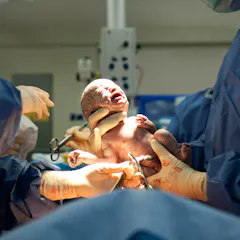
Despite efforts to reduce intervention rates during labour, vaginal births without medical intervention are becoming increasingly rare in Australia and overseas: nearly one in three women in Australian…
In an evolutionary sense, memory of pain serves an important purpose. Pain indicates a threat to our safety or our life, and human survival depends on us avoiding things that are going to kill us. Historically…
Sex. It’s what got you into pregnancy, but is it also the pathway to getting you out? Around a quarter of all Australian pregnancies are medically induced, with a third of those inductions occurring due…

The proportion of women who give birth by caesarean has risen dramatically in the developed world over the past few decades, with rates in Australia almost doubling, from 18% in 1991 to 31% in 2008. Until…
“Women aren’t dolphins” is a phrase often bandied about by those who question why women want to immerse themselves in pools or warm baths during labour and birth. They forget that we’re not mountain goats…
Millions of Australian women experience a pelvic organ prolapse, but they suffer in silence. This hidden epidemic is a well-kept secret and few people in the rest of the community know anything about the…
Women who use marijuana prior to pregnancy can more than double their risk of giving birth prematurely, new research has…
The number of unbooked births has doubled in 17 years according to data from the Australian Institute of Health and Wellbeing…
In response to a recent South Australian coroner’s finding that three babies died from preventable causes, Health Minister Tanya Plibersek has said she will close a loophole in national health laws that…

What to Expect When You’re Expecting is basically a 1980s frat film, complete with busty girls in bikinis, golf buggies crashing into swimming pools, and vomit and fart jokes – all window dressed with…
Women have the right to determine what happens to their bodies; and this includes where and how they give birth. But from July 2013, private midwives may not be able to legally provide their services…
Stillbirth is a major but under-researched public health problem affecting three million families each year. Following the 2011 Lancet Stillbirth Series, it has been receiving more attention, and a recent…
Electing to have a caesarean birth following one prior caesarean can lower the risk of serious complications for infants…
We live in a world with many different perspectives on risk. Entire professions now exist to advise us on how to recognise, avoid and manage risk. And the maternity and obstetric professions are no different…

Many women believe they’re likely to go through labour and give birth without medical intervention. But data from Victoria shows that, more often than not, labour does require intervention. The disconnect…
The proportion of Queensland women giving birth via caesarean section has increased by a staggering 74% in the past 20 years. This wouldn’t be of concern if more babies’ lives were saved as a result but…
We’re fortunate to live in a society where robust evidence forms the basis of the information health-care professionals provide to patients – and home birth should be no exception. But the evidence about…
Researchers have found that women experiencing high levels of stress are more likely to give birth to females. Scientists…
Top contributors
-

Professor of Midwifery, Associate Dean Research and HDR, Midwifery Discipline Leader, Western Sydney University
-
Caroline Homer is a Friend of The Conversation.
Deputy Director (Gender Equity, Diversity and Inclusion), Burnet Institute
-
Professor of Midwifery, Monash University
-
Assistant Professor of Obstetrics, Gynecology and Reproductive Biology, Harvard University
-
Professor in Midwifery, University of Sydney
-
Professor of Maternal and Child Health, University of Stirling
-
Senior Lecturer in Midwifery, Monash University
-
Associate professor, University of California, San Francisco
-
Professor of Midwifery and Dean in the Faculty of Health Sciences, Southern Cross University
-
Senior Research Fellow in Maternal and Reproductive Health, University of Hull
-
Associate professor, London School of Hygiene & Tropical Medicine
-
Associate Professor of Midwifery, Western Sydney University
-
NHMRC Early Career Fellow, The Kids Research Institute Australia
-
Lecturer, King's College London
-
Postdoctoral Fellow, University of Warwick