
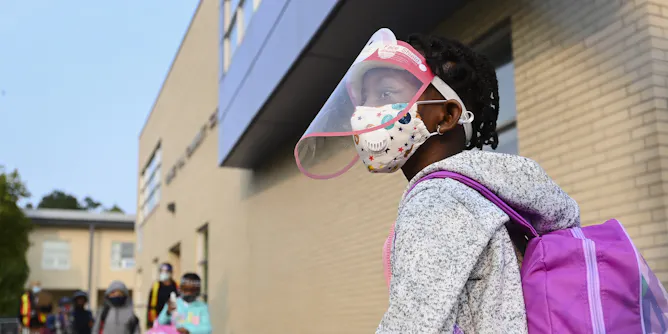
The COVID-19 pandemic risks making Canada’s already woeful record on child welfare worse. To safeguard a future for our children, governments must prioritize their care.
Articles on Child poverty
Displaying 61 - 80 of 109 articles

Emergency welfare relief during the pandemic shows ‘transformational’ child poverty action is politically and economically possible.

Visits between foster children and their biological families are being disrupted and reunification hearings delayed.

The earned income tax credit lifts around 6 million of the working poor out of poverty every year, but with the economy hammered by COVID-19, many might not get the benefit they need.

Intergenerational poverty affected children’s health in the 18th and 19th centuries – we must be aware of the risks today.

The pandemic response has put the long-term health and well-being of children and adolescents at risk, with the possibility of seismic shifts in population health if we do not act.

Free school meals have been an issue since 1906.

The millions of US children whose parents can’t always afford enough nutritious food for their families get about a quarter of their calories from what they eat at school.

Boris Johnson claimed in a BBC interview that child poverty was going down. An expert on child poverty looked at the data.
Child poverty has important psychological and social consequences. This means solutions need to cover very many different angles.

When thousands of New Zealand children were asked what well-being meant for them, most wanted enough money for basics, good relationships and to be free from bullying, racism and discrimination.

Ardern’s coalition government promised to overhaul New Zealand’s welfare system, but its response to a comprehensive report by an expert advisory group has been disappointing at best.
British children left angry and bewildered by food poverty.

The New Zealand government has set targets for reducing child poverty, but with hundreds of thousands of children living in poverty, this goal remains a challenge.

Poverty leaves people feeling unable to take responsibility for their future – but community programmes can empower young people to take control.

School’s out – but are the holidays equally enjoyable for all young people, or a time when inequality is magnified?

Education through to the end of high school is a birthright in Australia but many kids are missing out on important parts of that birthright in ways that leave them feeling like losers and outsiders.

The harsh realities of being a child in austerity-driven Britain – revealed.

There is a stigma attached to free school meals that causes parents to abstain from claiming them

A White House Council concluded that the war on poverty is “largely over.” But, while poverty among seniors has declined, poverty among adults and children as changed little over the last 40 years.
Top contributors
-

Director of the Roy McKenzie Centre for the Study of Families and Children, Te Herenga Waka — Victoria University of Wellington
-
Professor of Social Policy, University of York
-
Professor, Department of Social Policy, London School of Economics and Political Science
-
Distinguished Professor of Sociology and Public Policy, UMass Amherst
-
Chair professor, Glasgow Caledonian University
-
Professor of Law, University of Tennessee
-
Professor of Housing & Social Policy, HHAUS Housing, Homelessness & Urban Studies, Swinburne University of Technology
-
Professor of Public Policy and Economics, University of California, Berkeley
-
Professor of Law, University of Waikato
-
Reader in Food, Nutrition and Public Health, University of Westminster
-
Professor of Education and Social Policy; Director of the Institute for Policy Research, Northwestern University
-
Visiting Fellow, School of Policy Studies, University of Bristol
-
Honorary Associate Professor, Economic Policy Centre, Auckland Business School, University of Auckland, Waipapa Taumata Rau
-
Professor of Education and Public Policy, Durham University
-
Professor of Economics, University of Maryland; Director, Aspen Economic Strategy Group, University of Maryland