
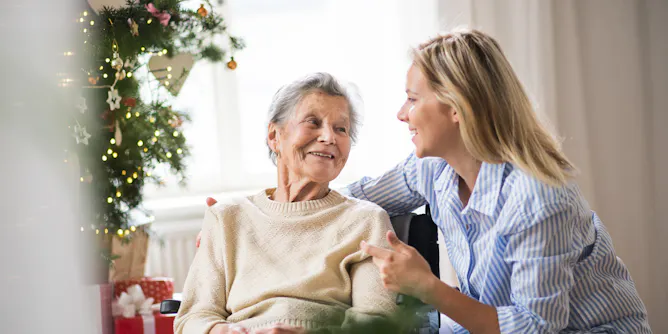
With a little forward planning and by keeping things flexible, everyone can enjoy end-of-year celebrations.
Articles on Carers
Displaying 21 - 40 of 62 articles

Carers can be left to figure it out for themselves, without support. Here’s what can help.

A reignited debate centres around whether broadening the diagnosis of autism has made the diagnostic label no longer entirely fit-for-purpose.

Respite care needs to be understood as a service for the carer as much as for the older person they care for.

Disabled single mother Shakira Hussein reflects on her secret weapon against adversity. Adalya, her ‘excessively mature’ daughter, appointed herself her mother’s carer and fierce protector from age 9.

While enrolments for men over the age of 25 increased, numbers fell for women in this age group. A likely reason for the difference is caring responsibilities, which increased during the pandemic.
A new system of carers’ leave would allow middle-aged Australians to care for their ageing parents while staying in the workforce.

Care facilities are often considered a last resort in South Africa. Personal care is assumed to be provided by family and household members.

People with mental illness are at their most vulnerable when they’re discharged from hospital. Without the support of family or friends at this time, they’re less likely to recover.

A study has found children between the ages of 8 and 14 who take care of a family member with a drug addiction or mental illness aren’t very happy at, and don’t feel all that safe, at school.

People suffering from mental illness face many challenges, but we don’t always notice the loved ones who do much of the caring behind the scenes.

Teaching robots to care for us in old age will be child’s play.

Why choice should not be the most important factor in elder care.

In a survey of 600 members of the screen industry, 74% of carers felt their caring responsibilities had a negative impact on their career. Of these, 86% were women.

The NDIS aims to help people with disability live more independently. It was hoped this would reduce carers’ responsibilities and allow them more time to work. But evidence shows this hasn’t happened.
The UK has one of the most developed palliative care services in the world, yet people still miss out.

While disability carers are employed to work part-time hours, they often have long work days with short periods of work interspersed with non-work periods.

Here are some tips if you are looking after someone who is nearing the end of their life.

Patient safety grabbed the attention when plans were mooted to move post-op people out of hospital and into private homes. But the project also moves important work into the shadows.

Medication usage has gone through the roof in the last decade.
Top contributors
-

Associate Professor, gender, ageing and care, University of Sydney
-
Adjunct Research Fellow, School of Public Health, The University of Queensland
-
Professor, Public Service Research, UNSW
-
Policy Director, Centre for Future Work at the Australia Institute and Adjunct Principal Research Fellow, RMIT University
-
Professor, Centre for Health Policy, Melbourne School of Population and Global Health, The University of Melbourne
-
Research Assistant at National Ageing Research Institute, The University of Melbourne
-
Professor of Trials for Older People, University of Newcastle
-
Professor in Ageing and Health, University of Sydney
-
Research Associate, Lancaster University
-
Head of Department of Psychosocial and Psychoanalytic Studies, University of Essex
-
Deputy Head of Research, School of Healthcare Sciences and Professor of General Practice, Bangor University
-
Professor of Children's Nursing, Edge Hill University
-
Post grad student at University of Edinburgh, University of Edinburgh
-
Distinguished Professor, Public Health and Medical Anthropology, University of the Witwatersrand
-
Professor of Sociology, University of Sheffield