
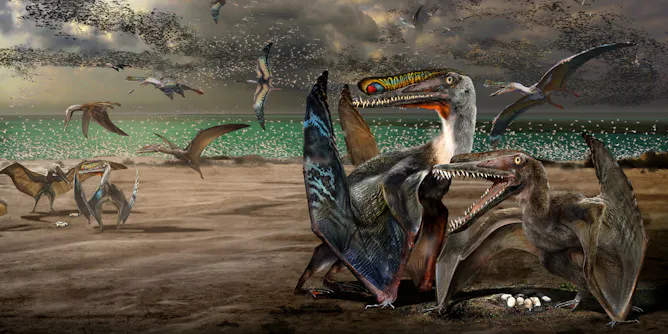
Reptiles don’t generally care for their offspring, but some pterosaurs may have bucked the trend.
Articles on Biomechanics
Displaying 21 - 40 of 81 articles

Revisions to the CDC’s developmental milestone checklists removed crawling as a skill that babies pick up at a typical age. A biomedical engineer describes how more research may clarify its role.
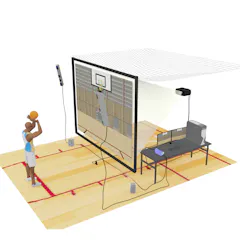
When we tweaked the simulator, talented players naturally adapted.
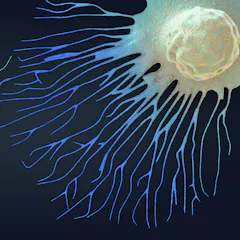
Counterintuitively, cells move faster in thicker fluids. New research on breast cancer cells explains why, and reveals the role that fluid viscosity plays in metastasis.
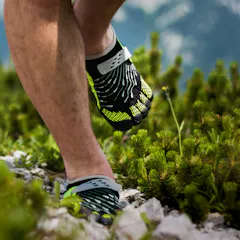
Thinking of trying barefoot running? We investigated a new strategy to switch from traditional shoe to barefoot running, and why barefoot running may work for some runners but not others.

Players can optimise their energy resources by adopting different styles when running in short bursts or longer periods.

How can they run and run and run for so long? What makes them so good at speedy changes of direction? Biomechanically, is there a certain body type perfect for football?
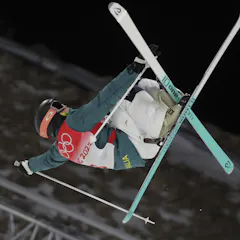
Executing the perfect manoeuvre on the slopes requires foresight, technical skill and being able to think on the go.
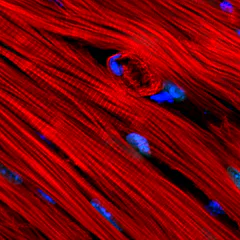
Heart disease can change the genetic structure of heart cells. Understanding the role that mechanical forces play in these changes could lead to improvements in artificial tissue design.

Understanding how brain folding works could help researchers better diagnose and treat neurodevelopmental disorders.
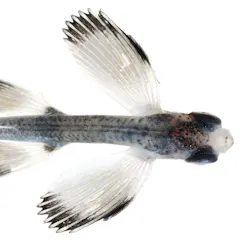
Fish fins are extremely flexible yet also strong. A special segmented fin design is the key to this useful combination of properties and could inspire new morphing materials.
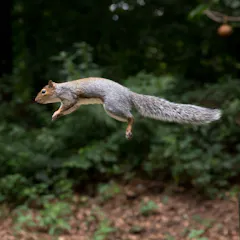
How do squirrels leap through trees without falling? It takes strength, flexibility and finely tuned cognitive skills.

Gymnasts need to carefully calibrate their leg muscles to gain optimum spring from the floor, springboard or beam. And their arms are crucial for balance and creating the right amount of rotation.

Usain Bolt can run at about 6 body lengths a second. An arachnid in California can do 322.

Swimming underwater reduces drag so much there are rules against doing it for too long. But the best swimmers make the most of what’s allowed.
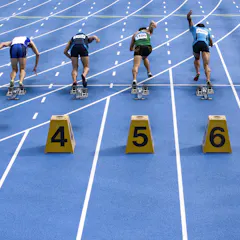
In track and field, it’s a common belief that middle lanes are the fastest. But according to the data, middle lanes aren’t better, and in the 200-meter sprint, outside lanes might even be faster.
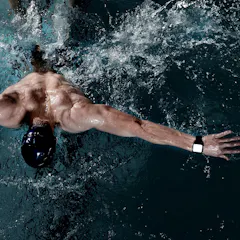
The future of wearable technology holds limitless potential for elite athletes to optimize and enhance their athletic performance.

From mythical beasts to extinct creatures, the pioneering special effects work of Ray Harryhausen inspired a generation of zoologists, palaeontologists and ecologists.
A high-tech twist on an old idea – running on springs – could give human-powered movement its biggest boost in more than a century.
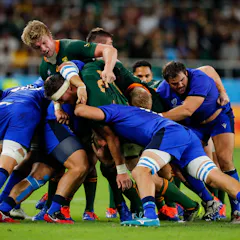
Body mass matters in rugby. But other factors play a bigger role in determining victory.
Top contributors
-

Professor of Biomechanics, Edith Cowan University
-
PhD Candidate in Biomechanics and Skill Acquisition, Victoria University
-
Professor of Biomedical Engineering and Rehabilitation Medicine, Emory University
-
Associate Professor in Perinatal Biomechanics and Health Technologies, University of Lancashire
-
Lecturer & Movement Scientist / PhD Sports Biomechanics, Flinders University
-
Lecturer in the School of Applied Sciences, Edinburgh Napier University
-
Lecturer in Biomechanics, University of Bath
-
Assistant Professor, Victoria University
-
Research Fellow, The University of Queensland
-
Associate Professor, University of Colorado Boulder
-
Professor of Mechanical Engineering, Northwestern University
-
Professor of Biological Sciences, Georgia Institute of Technology
-
Postdoctoral research fellow, University of Tasmania
-
Professor of Evolutionary Biomechanics, Royal Veterinary College
-
Research Associate in Ecology and Evolutionary Biology, University of Connecticut