

Social media provides both a forum for communication and a public signal about what a bank’s customers believe. That means Twitter can facilitate coordination in real time.
Articles on bank runs
Displaying all articles
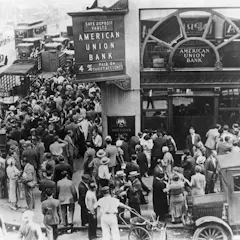
Crises fueled by bank runs, starting with the Great Depression, have had something in common: Unexpected changes spur bank failures, followed by general panic and then large-scale economic distress.

The failure of Silicon Valley Bank has raised questions about some of the consequences when the government steps in to protect the depositors of troubled banks.

The collapse of Silicon Valley Bank serves as a reminder of the importance of robust risk management, sound regulatory oversight and effective liquidity management.

Large Canadian banks are likely not at risk of bank failures, but history suggests smaller, more niche financial service firms could be.

The Fed, Treasury and FDIC acted swiftly to protect depositors and stem any panic, but anxiety continues to grow about the state of the global financial system.

The speed of SVB’s collapse was a surprise but central bankers can learn lessons from this failure.

Until Diamond and Dybvig published key papers in the early 1980s, it wasn’t well understood that perfectly healthy banks could be brought down by panicking depositors.
Top contributors
-

Associate Professor and Canada Research Chair in Banking and Insurance Analytics, Western University
-
Professor of Finance, Bocconi University
-
Professor of Finance and Distinguished Professor of Applied Investments, Appalachian State University
-
Assistant Professor of Finance, Arizona State University
-
Professor of Law, University of South Carolina
-
Fellow in Economics and History at Corpus Christi College, University of Cambridge
-
Associate Professor of Finance, University of Colorado Boulder
-
Professor of Finance and Business Economics, University of Southern California
-
Associate Professor, Gustavson School of Business and Lansdowne Chair in Finance, University of Victoria
-
PhD Candidate in Financial Modelling, Western University
-
Associate Professor of Finance, Mississippi State University