

Mental health problems keep people off work around five times longer than other types of injuries.
Articles on Bad management
Displaying 1 - 20 of 26 articles

Change management never quite goes according to plan. But it’s hard to figure out if Elon Musk even has a plan.

Not all people in banks are unethical, but banking attracts unethical people.

Very few companies have embraced alternative management systems that satisfy the interests of customers, employees and shareholders concurrently,

The risk of “pathocracy” is always close. And once entrenched, difficult to dislodge.

Once-leading firms such as Chrysler, Citigroup, Dunlop and Nokia have one thing in common: they failed. While each case seems unique, research points to key processes that lead to corporate failures.

Most Australian workers are fairly relaxed about their own job security, but they do worry about the risks of poor management and outsourcing to cheaper labour.

We may often criticise our lack of leaders. But leadership is not easy to define – even by leaders themselves.

Employees whose bosses give them some discretion over their work tasks are significantly more likely to engage in political behaviours outside work.

Trump’s reaction to the violence in Charlottesville, Virginia, prompted business leaders to sever ties with two White House councils.

Organisational psychopathy, generally known as toxic leadership, is common in the private sector. It’s emerging more often in the public space too.

Higher-ups at Wells Fargo, Volkswagen and Uber all failed to stop unethical practices that had significant repercussions. New research offers some clues on why.

People find meaning in their work for different reasons, but bad management can easily destroy it.

Employees who admitted to being emotionally manipulative in a survey may also be perceived as being emotionally intelligent in their workplaces, a study has found.

The fact that ambition, competence and interpersonal skills are not well correlated could explain why many managers struggle.

Three in ten leaders across the world are toxic. Toxic leaders destroy individuals as well as organisations, and affect the performance of a society and country.

There is an air of mysticism attached to high-growth companies: but in the main, they followed five golden rules.

It’s assumed good managers are intelligent, but do they also need emotional intelligence? And if that’s missing, can they learn?

Codes of conduct can be useful and strategic for employers, but too many are contradictory and vague.
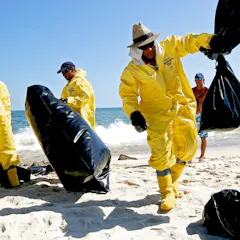
Before the 2010 Deepwater Horizon oil spill in the Gulf of Mexico, BP had previously gained high praise for its treatment of a similar spill.
Top contributors
-

Lecturer, College of Business and Economics, Australian National University
-
Professor, College of Business, University of Sharjah
-
Associate Professor in Human Resource Management and Industrial Relations, University of Technology Sydney
-
Professor of Organisation Theory, University of Bath
-
Former Professor and Head, Department of Industrial Psychology and People Management, University of Johannesburg
-
Associate Professor of Human Resource Management, The University of Western Australia
-
Assistant Professor of Management, Vanderbilt University
-
Senior Lecturer in Managerial Communication, MIT Sloan School of Management
-
Senior Research Associate, RMIT University
-
Associate Professor UTS Centre for Business and Social Innovation, University of Technology Sydney
-
Director, POLIS: The ANU Centre for Social Policy Research, Australian National University
-
Professor of Organisational Psychology, Griffith University
-
Associate Professor, College of Business, RMIT University
-
Professor of Economics and Public Policy, ANU College of Arts and Social Sciences, Australian National University
-
PhD, Griffith University