
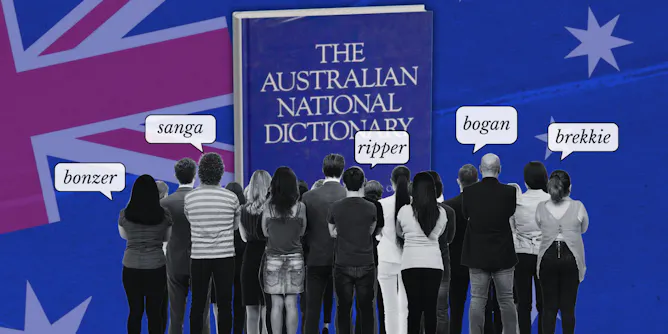
The dictionary is a living, breathing and evolving record of how language is wrapped up in who we are as Australians. It is vital we protect it.
Articles on Australian English
Displaying all articles
Yes, some slang certainly makes its way across the Pacific. But the history between the two versions of the English language is more complex than you might think.
New research shows there is still a lot of love for rhyming slang – but mostly among older Australians.

An extensive study is underway to catalogue Australian slang, its origins, and why it is such an important part of our language.
Times of crisis have always changed our slang, with the help of a little black humour. Coronavirus is no exception.

Could an Aussie high schooler say to our prime minister, “How’s it goin’, Mal?”, and get away with it? Probably.
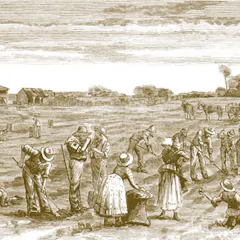
Irish influence on Australian English is much like the influence of the Irish on Australians themselves — less than you’d expect on the surface, but everywhere once you start looking.

Our drinking culture has brought some colourful phrases into the Australian vernacular.

Cult TV show Gogglebox is more than light entertainment: it shows the diverse reality of Australian English, going beyond stereotypes about what Australians sound like.
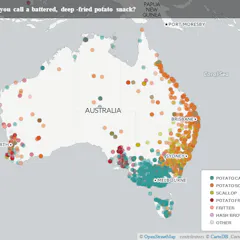
Australian’s care so much about regional differences in words because it’s a reflection on a person’s identity.

Within Australia, there has historically been a clear social distinction between Cultivated (British-oriented) and Broad or General, distinctly Australian ways of speaking.
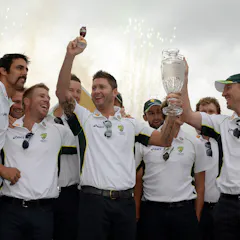
We could blame it on The Ashes. Last week, media outlets reported the Brits’ use of the Aussie accent might hurt their chances of promotion. But take a deep breath and two steps back from the 24-hour news…
Top contributors
-

Senior Lecturer in Linguistics, Monash University
-
Professor of Linguistics, Monash University
-
Associate Professor of Psychology, Australian National University
-
Adjunct associate, Australian National University
-
PhD student, ARC Centre of Excellence for the Dynamics of Language, Research Unit for Indigenous Language, School of Languages and Linguistics, The University of Queensland
-
Senior Lecturer, Linguistics, Monash University
-
Affiliate, ARC Centre of Excellence for the Dynamics of Language, Postgraduate researcher, School of Languages and Linguistics, The University of Melbourne
-
Emeritus Professor of Linguistics, Monash University
-
Adjunct associate, Monash University
-
Research fellow in Linguistics, Monash University
-
PhD Student, Monash University
-
Senior Lecturer in Writing, University of New England
-
PhD Candidate (Linguistics), The University of Melbourne