
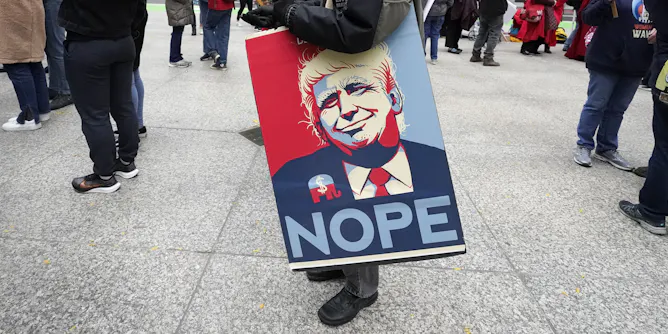
A Trump loss on Nov. 3 would demonstrate that the grassroots organizing of American women has paid off.
Articles on Amy Coney Barrett
Displaying 21 - 33 of 33 articles
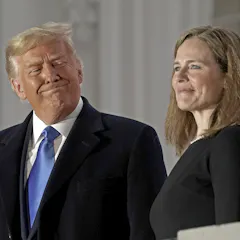
Republicans won the recent battle over nominations to the US Supreme Court with the appointment of Amy Coney Barrett. The loser might be the court itself.
The judicial theory has been a major talking point during the past three Supreme Court nominations. But what does it actually mean?
Democrats are outraged at what they say is the hypocrisy of allowing a president to appoint a new Supreme Court justice near the end of his term. One of their biggest practical concerns is the ACA.
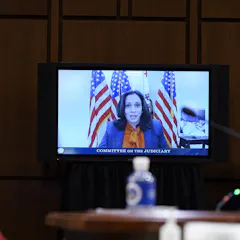
Though critics claim Amy Coney Barrett’s nomination jeopardizes the high court’s legitimacy, research shows there are ways the judiciary can bolster its standing and weather controversial decisions.

Taking oath is an important tradition before assuming charge of a public office. It entails a commitment to the future. What is the history of oath-taking?

If successful, Barrett would become the seventh current Supreme Court justice to be raised a Catholic, but more importantly the sixth conservative Christian.
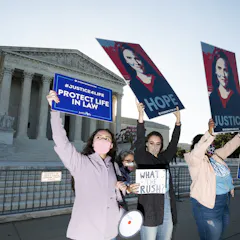
Special interests use the court as a public policy battleground. Here’s a rundown of how that works and which groups are likely to appear before a conservative court with Amy Coney Barrett on it.

With Amy Coney Barrett’s nomination, Trump has fulfilled his pledge to replace the late justice Ruth Bader Ginsburg with a woman. But female judges don’t all decide alike any more than male judges do.
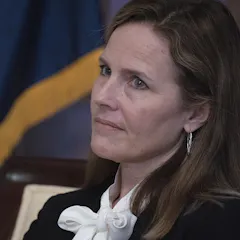
Barrett has written 15 opinions in cases involving employment law that offer a window into her nuanced approach to disputes between workers and employers.

Amy Coney Barrett may be a woman, but Trump’s other judicial appointments are 85% white and 76% male – the least diverse group of federal judges since Ronald Reagan.
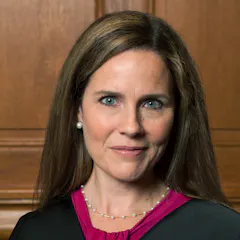
A more conservative court could choose cases that incrementally erode abortion rights, or they could push for reconsideration of the constitutional issues at the very heart of Roe v. Wade.

The Catholic charismatic movement in the United States began during the 1960s. The practices of Catholic charismatics encompass various forms of Pentecostalism.
Top contributors
-

Professor of American Civics, University of Tennessee
-
Professor of Legal Studies and Political Science, UMass Amherst
-
Professor of Political Science, Hamline University
-
President, Dickinson College
-
Visiting Teaching Assistant Professor of Political Science, University of Denver
-
Professor of Political Science, USC Dornsife College of Letters, Arts and Sciences
-
Associate Professor of Political Science, Oregon State University
-
Senior Lecturer in US History, College of Human Sciences and Culture, Flinders University
-
Professor of Religious Studies, College of the Holy Cross
-
Professor of Law, University of Oregon
-
Postdoctoral Research Scholar, Vanderbilt University
-
Senior Advisor to the Dean of the Faculty of Arts + Labour Management Relations, Toronto Metropolitan University
-
Professor of Law and Adjunct Professor of Political Science, Wayne State University
-
Associate Professor of Philosophy and Law, Wayne State University; Institute for Humane Studies
-
Enseignant au Moravian College de Pennsylvanie, doctorant au Laboratoire Interdisciplinaire De Droit et Mutations Sociales, Aix-Marseille Université (AMU)