
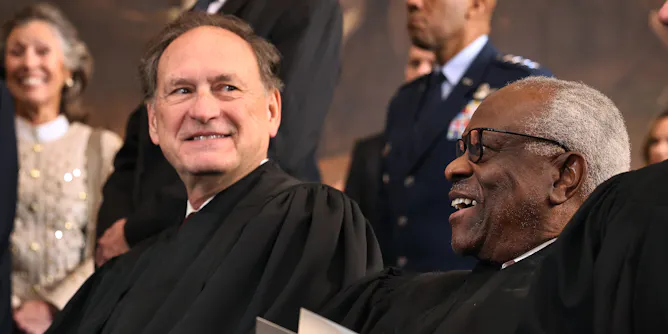
If a Supreme Court justice retires before the November midterms, this is how Trump and Senate Republicans can successfully confirm a successor.
Articles on Ruth Bader Ginsburg
Displaying 1 - 20 of 32 articles

Ninety years ago, Greenberg had a momentous decision to make: Should he play baseball on Yom Kippur?

A scholar of the Supreme Court and its relationship to the people of the United States says that President Joe Biden’s proposed term limits for justices can restore the court’s eroded legitimacy.

In the ugly spectacle of American politics, it’s hard to keep humanity in sight. But literature, says a poet and scholar of the classics, can remind us of what we know about growing old.

How does someone with power and fame walk away from it? It’s not easy, as these three examples from politics and sports show.

Are concerns about Supreme Court justices’ ethics an old problem, a new one, political gamesmanship, or something more serious? Yes to all of it.

Many years beyond the average American retirement age, politicians vie for power and influence. Their constituents tend to prefer they step back and pass the torch to younger people.
The changes wrought by the new conservative majority in the US Supreme Court are revolutionary.

In this play, RBG discusses her most famous cases and her conversations with three of the presidents who served during her 27-year term on the US Supreme Court.
Unlike in most countries, US Supreme Court justices enjoy life tenure. Some legal scholars believe that centuries-old custom, meant to protect judicial independence, no longer serves the public.

There was little controversy when President Bill Clinton nominated Stephen Breyer to the bench in 1994. His tenure on the Supreme Court reflects those less partisan times.

Unlike in most countries, US Supreme Court justices enjoy life tenure. Some legal scholars believe that centuries-old custom, meant to protect judicial independence, no longer serves the public.

Many states have found ways to remove partisan politics from their court systems.

Republicans won the recent battle over nominations to the US Supreme Court with the appointment of Amy Coney Barrett. The loser might be the court itself.
Democrats are outraged at what they say is the hypocrisy of allowing a president to appoint a new Supreme Court justice near the end of his term. One of their biggest practical concerns is the ACA.
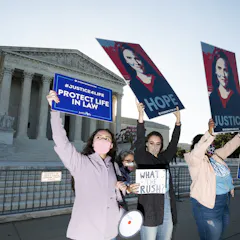
Special interests use the court as a public policy battleground. Here’s a rundown of how that works and which groups are likely to appear before a conservative court with Amy Coney Barrett on it.

With Amy Coney Barrett’s nomination, Trump has fulfilled his pledge to replace the late justice Ruth Bader Ginsburg with a woman. But female judges don’t all decide alike any more than male judges do.

Many Supreme Court nomination battles depended on whether the president’s party also had control of the US Senate.

A more conservative court could choose cases that incrementally erode abortion rights, or they could push for reconsideration of the constitutional issues at the very heart of Roe v. Wade.

The Catholic charismatic movement in the United States began during the 1960s. The practices of Catholic charismatics encompass various forms of Pentecostalism.
Top contributors
-

Professor of Legal Studies and Political Science, UMass Amherst
-
Professor of Political Science, Northern Illinois University
-
Associate Professor of American History and Politics, University of East Anglia
-
Professor of American Civics, University of Tennessee
-
Professor of Political Science, Trinity College
-
Clinical Professor of Law, Director of the International Human Rights Clinic, Rutgers University - Newark
-
Professor and Chair of History Department, Colorado State University
-
Professor of Public Policy, University of Maryland, Baltimore County
-
Lecturer, Screen Studies, The University of Melbourne
-
Associate Professor of Health Law, West Virginia University
-
Oliver Ellsworth Professor of Federal Practice & Professor of Law, University of South Carolina
-
Associate Professor of Law, The University of Sydney Law School, University of Sydney
-
Chairperson and Associate Professor of Law, College of Staten Island, CUNY
-
Professor Emeritus of Law and Adjunct Professor of Political Science, Case Western Reserve University
-
Adjunct Professor of Politics and Director of Think Again, University of Virginia