

African countries should start early to develop an agreed position before the next set of global priorities is discussed.
Articles on Africa Agenda 2063
Displaying 1 - 20 of 23 articles
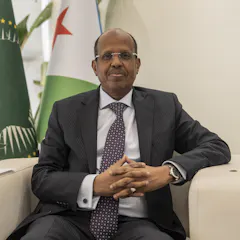
The new AU Commission chair promised to defend Africa’s fair representation and role in global forums. This is likely to be an uphill task.

African countries seem to agree that migration can link to development outcomes, but struggle with actually implementing it.

Regularising freer movement of people across African borders is one of the continent’s great developmental challenges.

The AU’s first two decades have largely represented a magical, mystical world of unfulfilled expectations.

Africa’s outer space programme can help the continent meet its other flagship goals.

Reasons why women’s voices are ignored in science reporting range from socio-cultural influences that inform gender norms, to perceptions of leadership and political power structures.
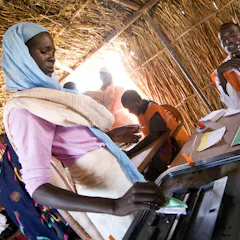
Surveys shows that the majority of Africans prefer democracy, despite its flaws, to the alternatives.
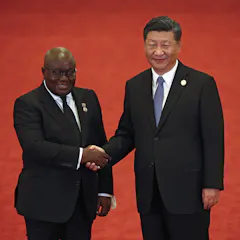
Not enough credit is given to the agency African governments have in their dealings with China.
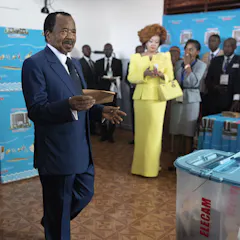
President Paul Biya’s credibility and legitimacy are increasingly being tarnished, amid growing support for opposition candidates.
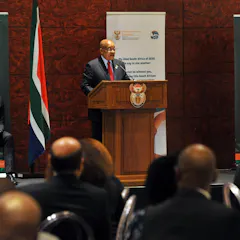
It’s important yet complicated to align national development plans with the SDGs. But it isn’t impossible.

Africa has recorded a tremendous growth in its output of academic engineering research over the past 20 years. Greater collaboration can increase this growth even more.
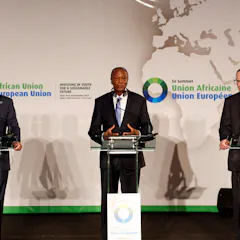
The transformation of the EU-Africa summit series into the EU-AU summit is more than just a change of name. It reflects the increasing recognition of the AU as an international actor.
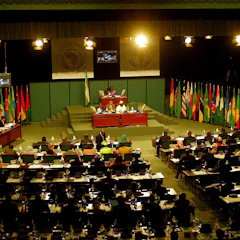
The limited “consultative and advisory powers” of the Pan African Parliament hamper the African Union’s ability to achieve a prosperous and peaceful Africa as envisioned in its Agenda 2063.
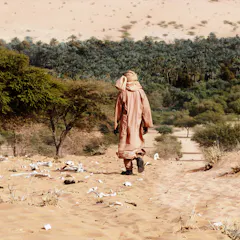
Africa’s great green wall suffers from a major mismatch between ambition and effort. But that’s not to say it should be ditched altogether.

Attempts to deepen democracy in Africa by limiting presidential terms to two have not entirely quashed a culture of entitlement to rule. Glimpses of it persist, much against citizens’ wishes.
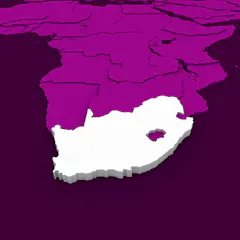
South Africa considers itself to be playing a key role in promoting the ‘African Agenda’ in continental and world affairs. But perceptions in the rest of Africa tell a different story.

Achieving greater freedom and equality for all identity groups is African democrats’ primary goal. By contrast, American democrats have traditionally been preoccupied with individual rights.
Africa has been called a “consumer continent” by many, but in reality much of what its people consume is produced elsewhere. Technology is key to Africa becoming a self-reliant producer of goods.
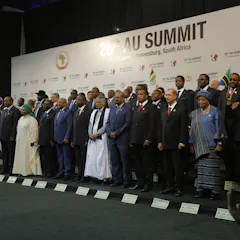
Silencing the guns in Africa by 2020 will require a Herculean effort on the part of the AU Peace and Security Council, whose remit is to prevent, manage and resolve conflicts.
Top contributors
-

Honorary Professor of International Relations, University of the Witwatersrand
-
Professor of International Relations, London School of Economics and Political Science
-
Chief Research Specialist in Democracy and Citizenship at the Human Science Research Council and a Research Fellow Centre for African Studies, University of the Free State
-
Adjunct Research Scientist, Swedish University of Agricultural Sciences
-
PhD candidate in Political Studies at the Department of Politics and International Relations, University of Johannesburg
-
Lecturer: African Politics and Political Conflict in the Department of Political Science, Stellenbosch University. He is also the Founding Editor of the ‘Journal of African Union Studies’, Stellenbosch University
-
Professor of Tropical Medicine, University of Oxford
-
Senior Research Fellow New South Institute, Emeritus Professor at The Nelson Mandela School of Public Governance, University of Cape Town
-
Research fellow, Institute on Comparative Regional Integration Studies (UNU-CRIS), United Nations University
-
Research fellow, University of Pretoria
-
Executive director, Africa Institute of South Africa, Human Sciences Research Council
-
Research Fellow at the Centre for the Study of Governance Innovation, University of Pretoria
-
Chair of Policy Innovation, School for Data Science and Computational Thinking, Stellenbosch University
-
EM Fellow, Université de Montpellier
-
Professor of International Law, University of Pretoria