

Challenges old and new confront young people in their efforts to get a useful education.
- Professor of Higher Education, Rhodes University, South Africa, Rhodes University

L’industrie du classement cible désormais les universités africaines, perçues comme un nouveau marché.

The ranking industry is targeting universities in Africa, which are seen as offering a new market.

Les universités devraient enseigner les bases de l'IA et insister sur l'importance de développer ses connaissances .

Universities should teach AI literacy, emphasise why developing knowledge is important and teach students why being an expert matters.

Les élèves ont pu se familiariser avec la pensée critique, l'écriture et le rôle plus large des outils d'intelligence artificielle tels que les chatbots.

Students could learn about critical thinking, writing and the broader role of artificial intelligence tools like chatbots.

Proctoring software is a symptom of a bigger problem: universities see themselves as businesses and students as customers.

While the pandemic undoubtedly sped up the uptake of educational technology in higher education, it doesn’t point to an entirely online future.

Universities that pay academics to publish their research should do so with caution.

Academics should speak out against a ranking process that positions all universities across the world as striving to be identical and competing for the greatest share of the market.

Many of the privileges that middle-class students enjoy are not obvious, even to themselves.

All institutions that offer doctoral-level qualifications are about to undergo a national review in response to the concerns about quality.

South Africa is ahead of the pack when it comes to research output in Africa. But this ranking is not a celebration.

These programmes allow institutions to claim they’re doing something without really tackling the issues that lead students to plagiarise.

Writing groups provide a space where the “rules of the game” of academia become clear.

It’s crucial to ensure that the academic project at universities is vigorously and bravely safeguarded.

Social class plays a huge role in people’s experiences of accessing and succeeding in higher education.

If there’s a general sense that academic publication is about knowledge dissemination rather than meeting performance targets, academics and universities become less vulnerable to predatory journals.

Student funding processes must be opened up to public scrutiny and participation if they’re to succeed.
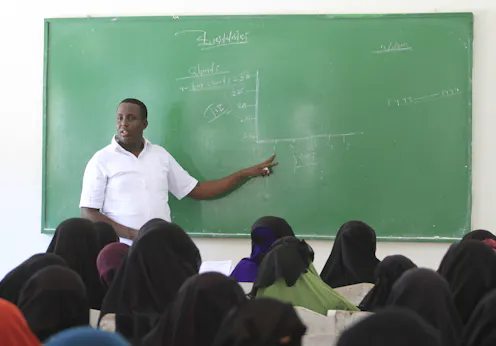
Teaching often comes second to research in universities. A group of award winning lecturers explains why teaching is the best part of their work.

Many universities in East and West Africa lost their autonomy during the 1980s and 1990s and became handmaidens of the state. What insights can their experiences offer for South Africa?

Students and academics are fed up with the situation at South Africa’s universities. One way to improve conditions is for universities to be run as institutions of learning – not big businesses.

Completing a PhD is a process that takes years. There are several ways to make this a happy, productive time rather than a period of endless misery.

For every student who intentionally steals others’ work and passes it off as her own, there are ten who don’t yet know how to build academic knowledge. They need our help, not condemnation.
Contact Sioux for
- General
- Media request
- Speaking request
- Consulting / Advising
- Research collaboration
- Research supervision
