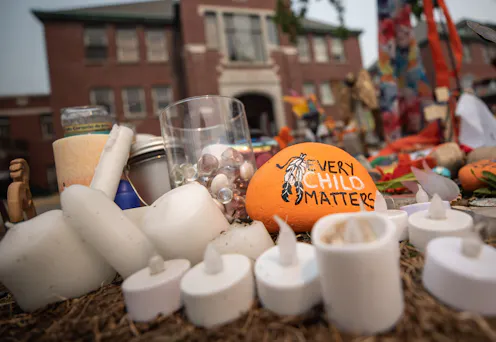
A rock with the message ‘Every Child Matters’ painted on it sits at a memorial outside the former Kamloops Indian Residential School, in Kamloops, B.C., in July 2021. THE CANADIAN PRESS/Darryl Dyck

We fact‑checked residential school denialists and debunked their ‘mass grave hoax’ theory

Contrary to what some ‘denialists’ believe, research shows that Canadian media outlets did not help circulate a ‘mass grave hoax’ regarding unmarked graves at former Indian Residential Schools.
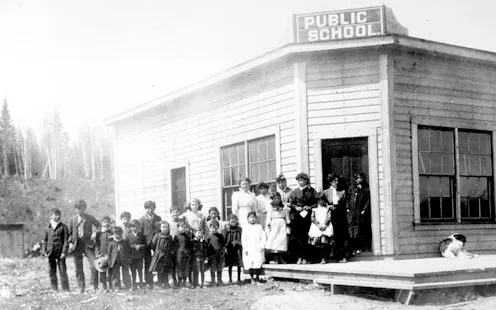
Alex Bird (second from the left) and his siblings from the Lheidli T'enneh First Nation were among the first students to attend this public school, near Prince George, B.C., in the early 1910s. (Royal B.C. Museum, Image B-00342, British Columbia Archives)

Reckoning with the history of public schooling and settler colonialism

In B.C., residential school principals sat on public school boards, and some Indigenous children even attended public schools. Understanding such links matters for truth and reconciliation.
A woman who attended an Indian Day School joins her daughter as they look at the Orange shirts, shoes, flowers and messages on display outside the B.C. legislature in June 2021. THE CANADIAN PRESS/Chad Hipolito

Canada’s reckoning with colonialism and education must include Indian Day Schools

People must learn more about the history and legacies of residential schools and day schools and understand their relationship to Canada’s colonial project.
Rally participants hold up signs and wear orange shirts as they march in support of residential school survivors and the families of missing and murdered Indigenous children in Winnipeg on July 1, 2021. THE CANADIAN PRESS/Mike Sudoma

Ignore debaters and denialists, Canada’s treatment of Indigenous Peoples fits the definition of genocide

A better understanding of what most genocide scholars believe can help people understand how Canada’s Indian Residential School system fits with the definition of genocide.
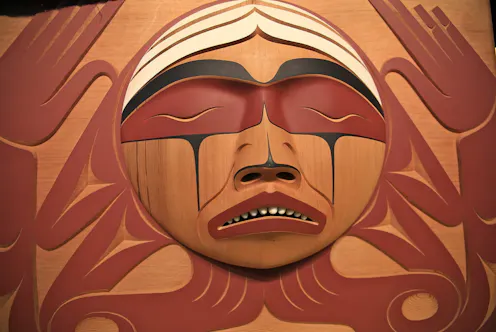
Cette boîte en bois cintré de la Commission de vérité et réconciliation, sculptée par Luke Marston, artiste salish de la côte, est un hommage aux survivants. (Eyesplash/Flickr)

La vérité avant la réconciliation : 8 façons de confronter les négationnistes des pensionnats pour autochtones

Le négationnisme des pensionnats pour autochtones est le rejet ou la déformation des faits fondamentaux les concernant afin de saper les efforts de vérité et de réconciliation.
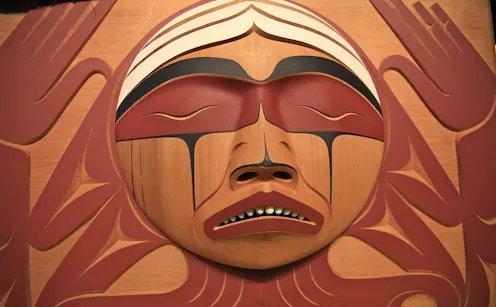
The Truth and Reconciliation Commission’s bentwood box, carved by Coast Salish artist Luke Marston, is a tribute to survivors. (Eyesplash/Flickr)

Truth before reconciliation: 8 ways to identify and confront Residential School denialism

Residential school denialism is the rejection or misrepresentation of basic facts about residential schools to undermine truth and reconciliation efforts.
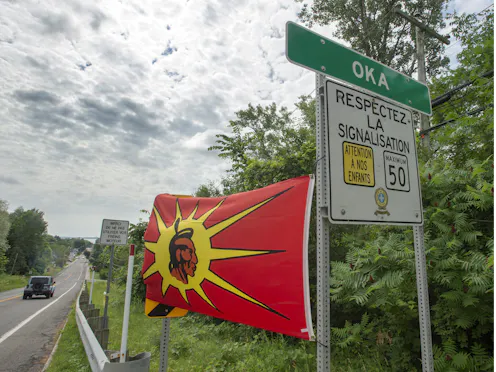
A Mohawk flag is placed at the border of the Mohawk territory of Kanehsatà:ke and the town of Oka in July 2019. THE CANADIAN PRESS/Ryan Remiorz

The legacy of Oka in an era of supposed reconciliation

The federal government must intervene to resolve the ongoing land dispute and show it’s serious about reconciliation.

Contact Sean for

  • General
  • Media request
  • Speaking request
  • Consulting / Advising
  • Research collaboration
  • Research supervision