

While the National Food Security Strategy does include important food systems initiatives, it fails to address the root causes of food insecurity or its health consequences.
Articles on Income inequality
Displaying 1 - 20 of 200 articles

Women’s unpaid work at home has declined much more than men’s contributions have increased.

Two researchers found that Danish government benefits do not fully offset moms’ lost earnings. But they do help offset lost income for working women with kids.
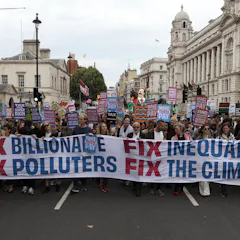
There is a great institutional need for strong inequality analysis. That’s why the world needs to establish an International Panel on Inequality.

Voters in the German city of Hamburg recently rejected the idea of a free payment for all residents.

In countries where income inequality is high, those who feel privileged are often more supportive of redistribution.

The typical worker on the verge of retirement is due roughly $412,000 in this under-the-radar wealth.

If Canada allows inequality to rise unchecked, it risks ending up where hundreds or ancient societies have: plagued by widespread unrest, violence and even complete collapse.

A recent report looks at the ongoing disparities racialized immigrant women face in the Canadian labour market.

Being viewed as a good corporate citizen can be good for the bottom line.

Low-income individuals face a double penalty: they are both more likely to need long-term care and they are less financially equipped to bear the associated costs.

Compared to countries we might benchmark against, New Zealand ranks poorly for inequality and the redistributive measures that would fix it. But other countries have shown it is possible to change.

When the benefit people get from owning a home is taken into account, Australia looks more like Canada than Switzerland.

The idea of passive income is often glamorized, but the reality is that many of these ventures require significant effort.

There are a number of reasons why there’s such a significant gap between aggregate economic numbers and the perceptions of everyday people.

The historical correlation between economic prosperity and increased life expectancy might suggest that growth is generally a good thing. However, other evidence points to the downside of growth.

Momentum on basic income is growing in Canada. However, pervasive myths about poverty are making implementing the idea challenging.

Research shows that when shareholders complain about pay gaps between CEOs and their employees widening, it can cause even more disparity.

Repugnance for certain activities tends to dictate government rules for markets but this can obscure real problems like poverty.

Money may not buy you happiness, but a favourite keepsake can boost happiness and wellbeing.
Top contributors
-

Part-Time Professor of Economics, The New School
-
Professor, Crawford School of Public Policy, Australian National University
-
Professorial Fellow and Co-Director, HILDA Survey, Melbourne Institute of Applied Economic and Social Research, The University of Melbourne
-
Nicolas Herault is a Friend of The Conversation.
Professor, Bordeaux Schoool of Economics, Université de Bordeaux
-
Associate Research Professor of Information Systems, Arizona State University; Institute for Humane Studies
-
Professor, ESCP Business School
-
Emeritus Professor, Department of Political Economy, University of Sydney
-
Professorial Fellow, Jumbunna IHL, University of Technology Sydney
-
Emeritus Professor of Economics (Griffith University) and Teaching Associate (University of Queensland), Griffith University
-
PhD candidate at the LSE and Research Fellow at the Superpower Institute, The University of Melbourne
-
Adjunct associate, Swinburne University of Technology
-
Associate professor, University of Sydney
-
Professor of Business and Society, University of Technology Sydney
-
Professor of Housing & Social Policy, HHAUS Housing, Homelessness & Urban Studies, Swinburne University of Technology
-
Research Professor in Social Policy, UNSW