

Chimpanzees bear genetic adaptations that help them thrive in their different forest and savannah habitats. Some of the adaptations may protect against malaria.
Articles on Wild chimpanzees
Displaying all articles

When resources are tight, mothers bear the costs of playing with their offspring even as they avoid socializing with others.
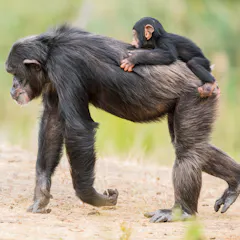
To understand the barriers endangered species face when trying to traverse their habitat, it helps to think of their environment like an electrical circuit board.
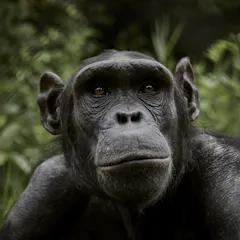
But with chimps now endangered, we risk losing their forest-rebuilding abilities.
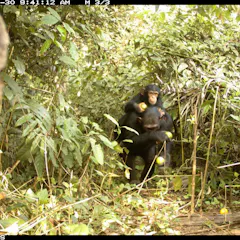
Studies show that West Africa’s critically endangered chimpanzees are finding ways of adapting to their rapidly changing habitat, but they still remain highly at risk.
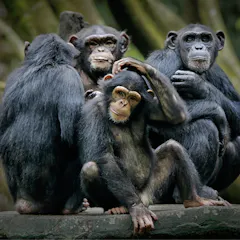
Our closest relatives show distinct cultural behaviour in different populations. But those differences are being erased.
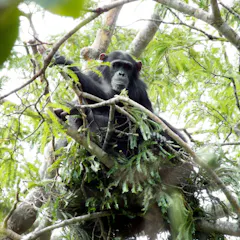
Early hominins are thought to have made a new shelter every night, which taught them how to adapt to changing conditions.
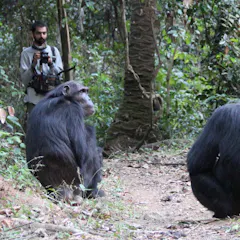
Do chimpanzee talk to each other? Scientists follow and record chimpanzees in the wild to find out – and to fill in details about how human language might have evolved.

Wild chimpanzees are hard to find, but their DNA – left-behind genetic traces – are opening up a new way of studying them.
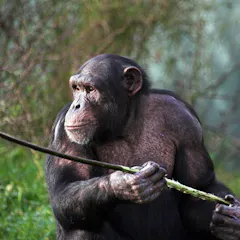
New, fascinating observations about the behaviour of wild chimpanzees showed that they can apply a complex technique to access honey.
Top contributors
-

Asso. Professor in Anthropology, University College London, UCL
-
Lecturer in Wildlife Conservation
-
Former Doctoral student Department of Primatology
-
Associate Professor of Ecology, Evolution and Behavior, University of Minnesota
-
Senior Lecturer in Primate Conservation, University of Kent
-
PhD Candidate in Conservation Biology, Liverpool John Moores University
-
Assistant Professor of Anthropology and Biology, Tufts University
-
Fellow in Human Evolutionary Biology, Harvard University
-
Research Fellow, Primate Models for Behavioural Evolution Lab, University of Oxford
-
Field researcher, Universitat Autònoma de Barcelona
-
Scientist, UCL Genetics Institute, UCL
-
Professor of Population and Evolutionary Genomics, UCL
-
Staff Scientist, Max Planck Institute for Evolutionary Anthropology
-
Research Associate, Geography, University of Sussex