

Designed to ease budgetry pressures, households in Scotland on Universal Credit can now opt for a fortnightly payment instead of being paid monthly.
Articles on Welfare reform
Displaying 21 - 40 of 80 articles

The minimum wage may be adequate for some low-paid workers – but this is clearly not the case for the woefully inadequate Newstart Allowance.
Trump’s rationale for cutting the Temporary Assistance to Needy Families program rests on a myth at odds with contemporary data.
Christian Porter said Australia’s welfare system ‘was costing over 100% of all income tax raised’ under Labor after the GFC, and that it’s ‘around 80%’ under the Coalition. Is that true?

Social Services Minister Christian Porter told Q&A that ‘rates of drug use amongst unemployed are 2.5 times higher than amongst employed people’. Is that correct?

The latest welfare changes will hurt low-income families and breach Australia’s human rights obligations.

Fewer than half a million people are currently receiving the new, simplified benefit according to newly released data.

Housing affordability is often not the only problem households face. More often the compounding effects of multiple problems leave people unable to cope, which is why one solution won’t work for all.
By far the most significant projected savings in the government’s omnibus bill is the phasing out of end-of-year supplements for family tax benefit recipients.

Centrelink’s debt recovery problems reflect an over-simplistic application of policy to the complexity of workers’ lives in a flexible labour market.
The proof of whether an investment approach to welfare actually does improve outcomes for the disadvantaged is still some years down the track.
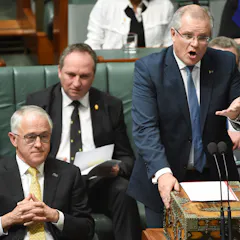
We need to ask on what basis the government is making its budget savings a ‘moral’ issue, and how the opposition can possibly support it.
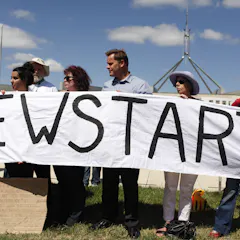
The Asylum Seeker Resource Centre’s Kon Karapanagiotidis said that what a politician can claim for a one night stay in Canberra is equivalent to an entire week on Newstart. Is that true?

A new report highlights how little we know about what works and what doesn’t when it comes to publicly-funded Indigenous programs. It’s a similar story in other policy areas – but we can do better.

On the 20th anniversary of Bill Clinton’s promise to “end welfare as we know it,” a social work scholar asks why child poverty is still such a problem in the U.S. and what race has to do with it.

Relationship education programs are meant to strengthen low-income couples, with the idea children would benefit. But focusing on communication skills overlooks what really matters to these Americans.

Is the Coalition right to say that, at any one time, there is around $3.5 billion of debt to the Commonwealth due to fraud, non-compliance or misreporting in the welfare system?

Australia should learn from the failings of New Zealand’s investment approach to welfare.
What’s in store for key policy areas, from health to education to infrastructure to asylum seekers, under a returned Coalition government?

The welfare state was not designed for the modern world of temporary and casual work or multiple jobs. Is universal income the answer?
Top contributors
-

Professor, Crawford School of Public Policy, Australian National University
-
Professorial Fellow, Jumbunna IHL, University of Technology Sydney
-
Professor & Director, Jeff Bleich Centre for Democracy and Disruptive Technologies, Flinders University
-
Professor, College of Business, Government & Law, Flinders University
-
Professorial Fellow, University of Canberra
-
Adjunct Research Fellow, School of Government, Te Herenga Waka — Victoria University of Wellington
-
Professor of Social Development Studies, University of Johannesburg
-
Professor of Social Policy, University of Kent
-
Professor of Citizen Participation, University of East Anglia
-
Professor of Electrical and Electronic Engineering and Deputy Dean Research at Faculty of Engineering and Information Technology, The University of Melbourne
-
Research Associate, School of Social Sciences, Monash University
-
Director, Institute for Governance and Policy Studies, Te Herenga Waka — Victoria University of Wellington
-
Professor of Urban Policy and Director, Urban Futures Enabling Impact Platform, RMIT University
-
Chair, The Conversation Media Group
-
Honorary associate professor of economy and society, Macquarie University