
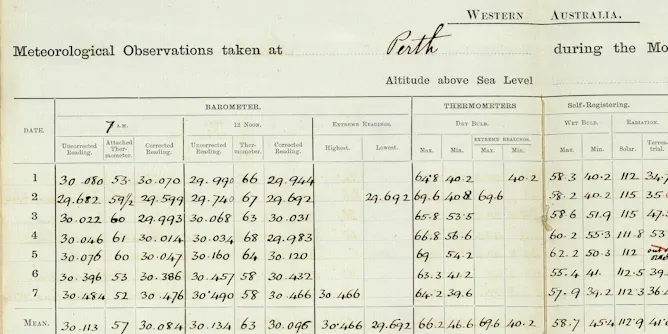
How did Australia’s climate fluctuate before the large-scale burning of fossil fuels? Old records can help us find out.
Articles on Weather records
Displaying 1 - 20 of 26 articles
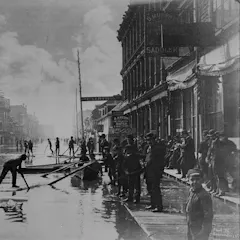
With weather records dating back hundreds of years, it’s possible to track everything from sudden downpours that led to flash floods to the slow changes that occur over centuries.

The growing threat of flash flooding as a result of more intense rapid rain bursts means the city needs to update its flood defences.
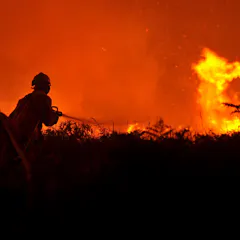
The strongest signal of our changing climate flares while most of us are asleep.
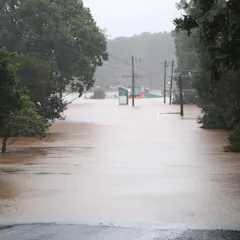
Flood clusters are not unknown - but what’s new about the floods hitting Lismore is the unprecented height.
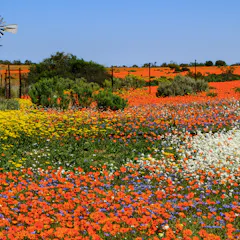
The progressively earlier flowering places the daisies at greater risk of failed flowering seasons. This would be a blow to biodiversity and tourism.

The US is shifting to a new set of climate ‘normals’ – data sets averaged over the past 30 years. But normal is a relative concept in a time of climate change.

Humans are not very sensitive to changes in air pressure, but they can have a big effect on the weather.
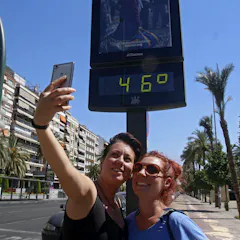
In an unchanging climate, we would expect record-breaking temperatures to get rarer as the observation record grows longer. But in the real world the opposite is true - because we are driving up temperatures.
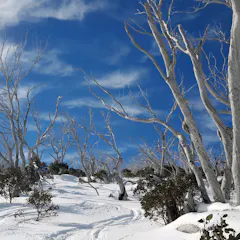
Three years ago The Australian newspaper launched a broadside at the Bureau of Meteorology. But when it did it again this week, it seemed to get less traction from the top echelons of government.
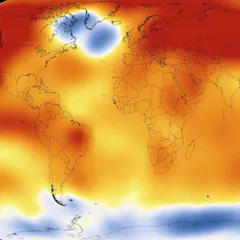
A new analysis suggests that weather records have not yet had time to capture the full effects of climate change, some of which are likely to take centuries to play out.
Weather forecasting stopped looking for patterns in the past, and started using numbers to look solidly at the future.
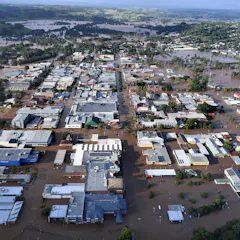
The record floods of 1954 and 1974 still stand as Lismore’s high-water marks. But Tropical Cyclone Debbie delivered her deluge far more abruptly than the rains that triggered those historic floods.
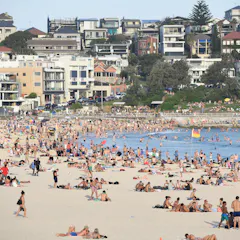
New South Wales has just had its hottest summer on record – an event that was made 50 times more likely by humans’ impact on the climate.
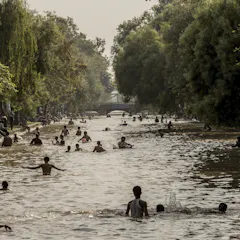
Across the globe, extreme heat events are linked with climate change, although El Niño provided a boost in 2015 leading to more records being broken.
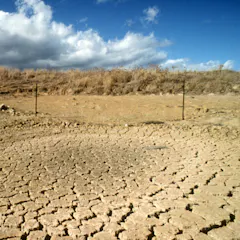
A new millennium-long record reveals that Australia has suffered longer droughts and wet periods than those recorded in the past century’s weather observations.
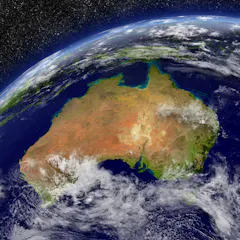
Former PM’s business advisor Maurice Newman recently claimed that satellite temperature data tell a different story to data collected on the ground. He’s right - but that’s how it’s meant to be.

2014 saw heatwaves of all kinds and other wild weather. Research can now explain that climate change made these events much more likely.
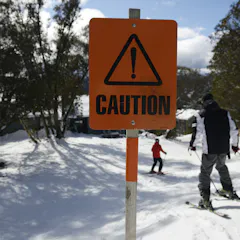
Melbourne, Canberra and much of southern Australia have shivered through a cold winter. But on a longer view, record cold snaps are disappearing, while Australian heat records continue to be broken.

Attacks on institutions that keep records of global temperatures, such as NASA, the US National Oceanic and Atmospheric Administration, the UK Met Office, and Australia’s Bureau of Meteorology, continue…
Top contributors
-

Professor emeritus, School of Earth, Atmosphere and Environment, Monash University
-
ARC Future Fellow and Associate Professor in Climate Science, ARC Centre of Excellence for 21st Century Weather, The University of Melbourne
-
Professor emeritus, The University of Melbourne
-
Visiting Fellow in Meteorology, University of Reading
-
ARC DECRA Fellow, UNSW
-
Honorary Associate Professor of Climate Science, The University of Melbourne
-
Deputy Director, Engagement and Impact, The ARC Centre of Excellence for the Weather of the 21st Century, Australian National University
-
Chief Investigator ARC Centre of Excellence for Climate Extremes and Professor Climate Change Research Centre, UNSW
-
PhD Candidate, The University of Melbourne
-
Associate Professor – Hydroclimatology, University of Newcastle
-
Senior Research Scientist, CSIRO
-
Research Assistant, UNSW
-
Palaeoclimatologist, Australian Antarctic Program Partnership, University of Tasmania
-
Lecturer in Twentieth and Twenty-first Century Literature, Durham University
-
Assistant Director of the Global Systems Institute, University of Exeter