
How did the numbers of election 2019 fall across the country? And what seats are still in play?
Articles on US Senate
Displaying 201 - 220 of 410 articles
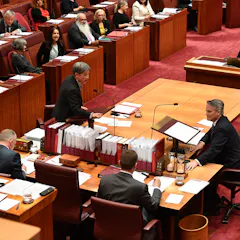
With the higher quota at a half-Senate election, parties probably need at least 5% of the vote to be in contention for a seat at this election.

The Greens’ fortunes have fed off Labor’s performance: a weakened Labor means more support for the Greens. But this election the party is more likely to maintain its parliamentary presence.

Tim Colebatch on the battle in Victoria - and the Senate
Colebatch says three Victorian seats are "pretty certain" Labor wins - Dunkley, Corangamite and Chisholm. A number of others "are really open" - Casey, La Trobe, Deakin, Flinders and even Higgins.
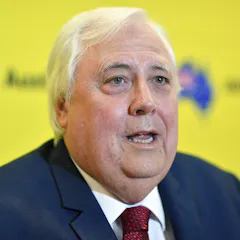
Seat polls are notoriously unreliable, and the support shown for the United Australia Party in recent polls is likely to be overstated.
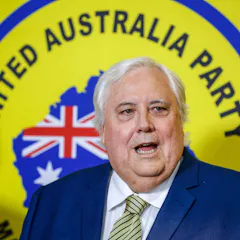
Unchastened by his experience in federal parliament between 2013 and 2016, Clive Palmer and his United Australia Party are back - and beginning to make their presence felt in polling.
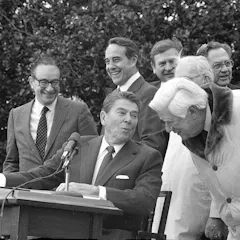
Most Congresses since the 1970s have passed more than 500 laws, ranging from nuclear disarmament to deficit reduction. Will today’s bitter partisanship hamstring the new Congress’ productivity?

Soon we’ll have a better idea of what we are buying. There are no penalties, but “naming and shaming” might make Australia’s Modern Slavery Act work.
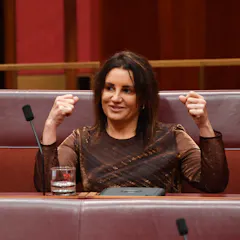
The Institute’s analysis suggests that, at best, after next year’s half-Senate
election the ALP and Greens could have 38 senators – although more likely they would have 37.
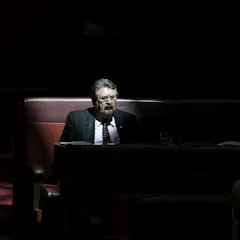
Politics with Michelle Grattan: Derryn Hinch on a national ICAC and the Victorian election
CC BY33.8 MB (download)
The government is more likely to beef up existing institutions but Derryn Hinch, who has been a strong advocate for a national ICAC, says "that would be wrong."
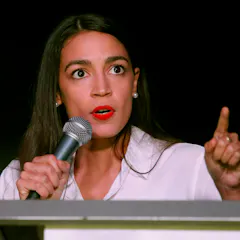
In the next Congress, white men will make up 60 percent of the House and 71 percent of the Senate – a historic low.
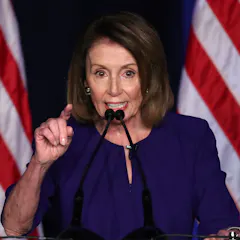
As House Democrats prepare their agenda for the next two years, dealing with America’s massive fiscal gap should be at the top of their list.
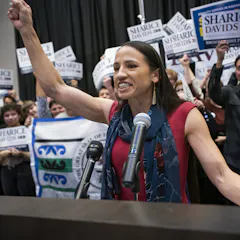
Several states now have their first female senator and more than 100 women will enter the House of Representatives.
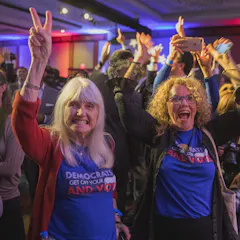
The highly-anticipated US mid-terms produced mixed results for both major parties – Democrats won the House but Republicans strengthened their hold on the Senate.
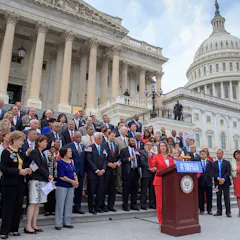
While a divided Congress will likely mean gridlock, there are two economic policies likely to see significant change: trade and infrastructure.
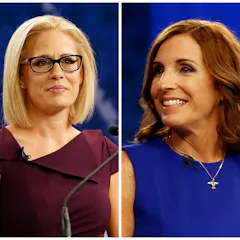
Two accomplished women are running against each other to replace Sen. Jeff Flake.
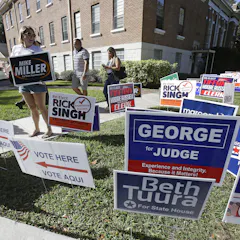
Is money the root of all evil in politics? It’s easy to see a correlation between winning and fundraising – money flows to likely winners and competitive races. But correlation is not causation.

One would think ministerial staff would be particularly alert to Hanson motions, and think very carefully before concluding she was doing something as unlikely as putting forward an anti-racist one.
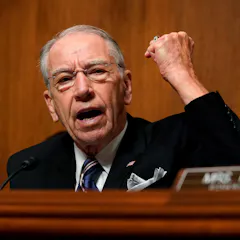
Legal scholars offer a vision for appointing Supreme Court justices more fairly. While it wouldn’t require any constitutional amendments, it would require Congress to pass a bill.
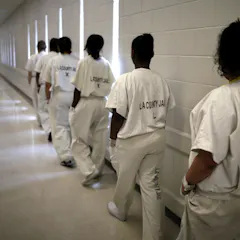
A new public opinion survey reveals Americans largely agree on sentencing reform, and how money spent on prisons could be reinvested in communities.
Top contributors
-

Professorial Fellow, University of Canberra
-
Election Analyst (Psephologist) at The Conversation; and Honorary Associate, School of Mathematics and Statistics, The University of Melbourne
-
Associate Professor of Political Science, Boise State University
-
Senior Lecturer, Department of Languages and Linguistics, La Trobe University
-
Senior Lecturer, School of Political and Social Inquiry, Monash University
-
Associate Professor of Political Science, Westminster College
-
Associate Professor in Law and Public Policy, University of Oxford
-
Professor of Political Science, University of Florida
-
Professor of law and ethics, Georgia State University
-
Associate Professor of Political Science, Rochester Institute of Technology; Institute for Humane Studies
-
Distinguished Fellow in Law and Government, Dickinson Law, Penn State
-
Professor in The Division of Global Affairs and The Department of Political Science, Rutgers University - Newark
-
Professor of Political Science, Drake University
-
Professor of Politics, University of California, Santa Cruz
-
Associate Professor in Politics and International Relations, School of Social Sciences, Monash University