
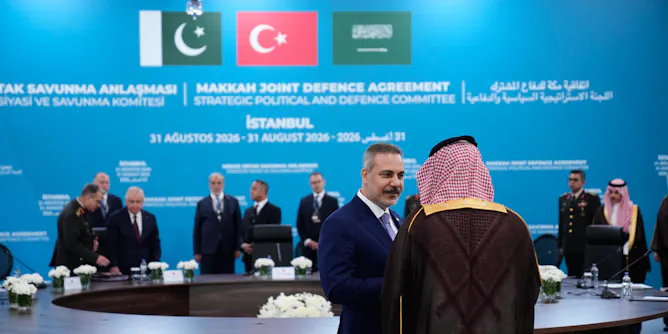
The pact with Turkey and Pakistan has evolved quickly from a vague political commitment. Riyadh hopes it will help it navigate a thorny Middle East crisis.
Articles on Turkey
Displaying 1 - 20 of 532 articles
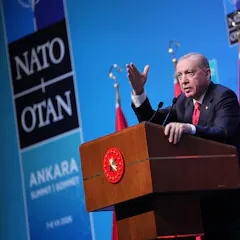
Recep Tayyip Erdoğan doesn’t want others defining Turkey’s choices. He’s seeking a better position within an existing world order and recognition that Turkey is entitled to forge its own path.
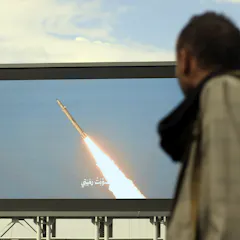
Saudi Arabia’s escalating conflict with the Houthis in Yemen will force its new defence partners Turkey and Pakistan to confront some difficult questions.
Are education systems succeeding in transforming individual abilities into collective opportunities? This is what rankings ought to be measuring rather than reducing education to a few figures.

Both sides say they do not want war. But both have soldiers in Syria, raising the risk of miscalculation.

The Mecca agreeement is best understood as a form of strategic insurance for three governments seeking greater protection and political influence beyond traditional American guarantees.

Dubbed an ‘Islamic Nato’. the pact reflects disillusionment among some of America’s allies.
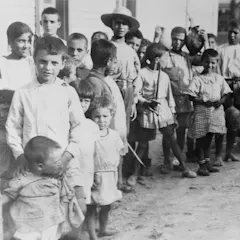
Passed down through generations, refugee memories morph through the different stages of trauma, from silence to a reawakening.
The story of oil is focused on the US. But our oil-centred world was made through wider global relations.
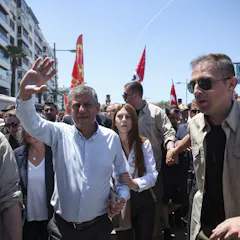
Nullifying the leader of Turkey’s main opposition party is the latest in a string of measures that are taking the country down the road to autocracy.
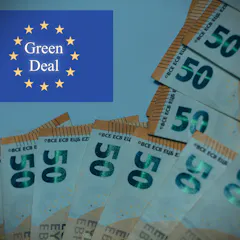
Amid the ongoing energy crisis, climate economics experts assess how much export credit agencies are actually driving the shift to lower-carbon as they focus financing on green energy.

Foreigners have been shaping Ghana’s built environment for centuries.

The folk tales of Nasreddin Hoja, which likely originated in 13th-century Turkey, carry many lessons for us today.
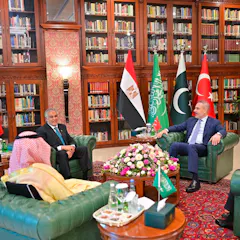
Pakistan played a leading role in negotiating the ceasefire in Iran.
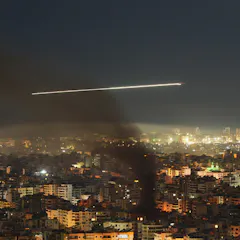
Israel’s recent actions are changing the Middle East by weakening state capacity and sustaining regional tensions.

Countries don’t just switch from fossil fuels to renewable energy sources. Each takes its own path, depending on its economy, international trade relations and government stability.
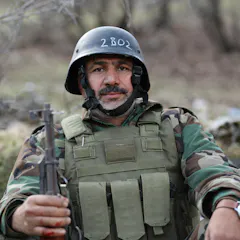
Washington may see the Kurds as a useful tool for confronting the Iranian regime, but such a strategy could create new tensions elsewhere in the region.
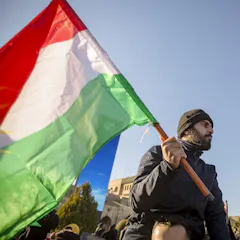
Washington has long worked with Kurdish groups in the Middle East. But without sufficient support, encouraging Iranian Kurds into an uprising now could be dangerous.
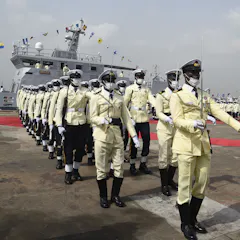
Across Africa, governments are finding ways to reduce dependence on foreign arms suppliers and building capabilities they can control, maintain and adapt.

Diasporas are often treated by media and policymakers as monolithic blocs, but the reality is more complicated.
Top contributors
-

Dean of Jimmy and Rosalynn Carter School for Peace and Conflict Resolution, George Mason University
-
Associate Lecturer, Faculty of Social Science, The Open University
-
Professor of Islamic Studies, Head of School, The Centre for Islamic Studies and Civilisation, Charles Sturt University
-
Associate professor, London Metropolitan University
-
Professor of Political Science, Director of Center for Islamic & Arabic Studies, San Diego State University
-
Professor in Political Science and International Relations, Durham University
-
Professor in the Department of Government, University of Essex
-
Professor of Finance, King's College London
-
Assistant Professor in Global Humanities, Simon Fraser University
-
Henry J. Leir Professor of Practice in Economics of the Middle East, Brandeis University
-
Associate Professor of Political Science, Department of Political Science and Researcher, Centre for Advanced Middle Eastern Studies, Lund University
-
Postdoctoral research associate, European University Institute
-
Professor of International Politics, Clinton Institute, University College Dublin
-
Professor, New Media and Communication Department, Istanbul Bilgi University
-
Assistant Professor in Politics and International Relations, University of Nottingham