
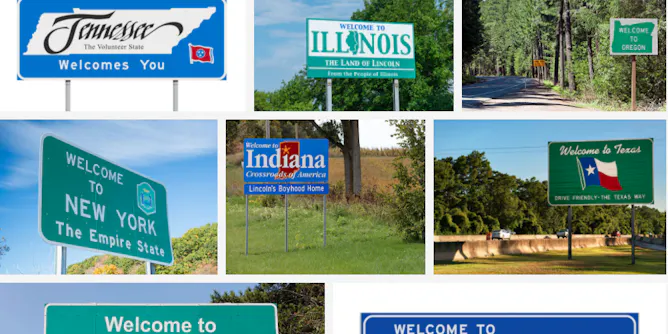
The U.S. is broken up into 50 states, plus territories like Puerto Rico and Guam, and a federal district, Washington, D.C. Most other countries have smaller parts too.
Articles on States
Displaying 21 - 40 of 56 articles
Websites that crash. Appointments that fill up within seconds. Scheduling your COVID-19 vaccine shouldn’t be this hard. A few states have found a better way.

Getting pharmacies more involved could be a game changer, particularly for reaching minorities, older adults without internet access and others left behind.
Palmer has lost his challenge to the closure of the Western Australian border in response to COVID-19. But it still remains unclear whether the border closure was and remains valid.

States have been experimenting with more targeted approaches to slow the coronavirus’s spread. Two strategies stand out.
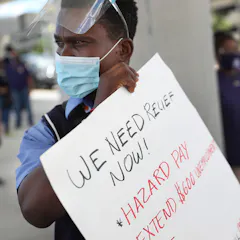
Slow, unreliable labor force data have consequences for out-of-work Americans and the economy.
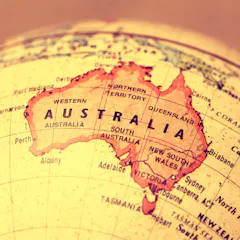
We’ve compiled the key COVID-19 restrictions in place across the states and territories.

The pandemic isn’t just a health disaster. It’s a disaster for cities and states, where the money to run government that normally comes in every year has evaporated. Congress may or may not help.

A close look at Florida’s economy shows just how vulnerable the state and its population are to a pandemic, and some of the reasons state officials hesitate to take action.

Many of the public employee pension plans run by states don’t have enough money in them to make upcoming pension payments to retired state workers. The pandemic could make that problem much worse.

Since the state’s first coronavirus case surfaced, trained case investigators have traced the contacts of every person who tested positive. Here’s what else South Carolina got right.

States should only open their borders once they have eliminated coronavirus – and should only open them to states which have similarly achieved disease elimination.

What is a state’s balance of payments, and why do some pay so much more? An author of a report at the heart of debates over which states should get coronavirus relief funds breaks it down.

How and when the US economy reopens will look different state to state, and for good reasons. This Q&A explains why, and why some states are working together.
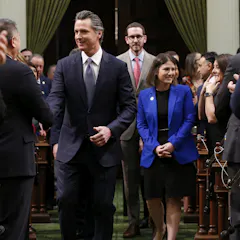
As Congress considers further financial help for victims of the coronavirus pandemic, the magnitude of the fiscal crisis that governors and their states will have to face is just starting to emerge.

The rise of global cities, metropolises that dominate their states, is exposing Australia’s lack of metropolitan governments. It’s time to restart the evolution of our states after a century on hold.
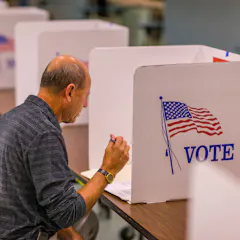
If you want to understand the American public, don’t look at national poll numbers.

Hillary Clinton got the most individual votes from US citizens in 2016, but Donald Trump won the most electoral votes.

A quirk of mathematics gives voters in some small states, like Rhode Island and Nebraska, an extra edge over voters in other states. This happens not only in the US, but in other countries, too.

Nationwide, state government money has become a smaller and smaller fraction of public higher education budgets.
Top contributors
-

Professor of Law, Australian Centre for Health Law Research, Queensland University of Technology
-
Associate Professor of Health Policy and Management, Texas A&M University
-
Associate Dean for Research and Professor of Health Policy and Management, Texas A&M University
-
Distinguished Professor, Professor of End-of-Life Law and Regulation, Australian Centre for Health Law Research, Queensland University of Technology
-
Professor of Public Policy (retired), University of Virginia
-
Professor and Neustadt Chair, Department of Agricultural Economics, Oklahoma State University
-
Distinguished Fellow, Sustainable Solutions Lab, UMass Boston
-
Associate Professor of Law, Adelaide University
-
Vice Chancellor's Fellow at Victoria University and Adjunct Professor of Economics, Victoria University
-
Professor of Political Science, The University of Melbourne
-
Lecturer, Public Sector Finance, University of Canberra
-
Executive in Residence, American University School of Public Affairs
-
Postdoctoral Researcher, Trinity College Dublin, Trinity College Dublin
-
Lecturer in Political Theory, University of Manchester
-
Associate Professor in Law and Public Policy, University of Oxford