
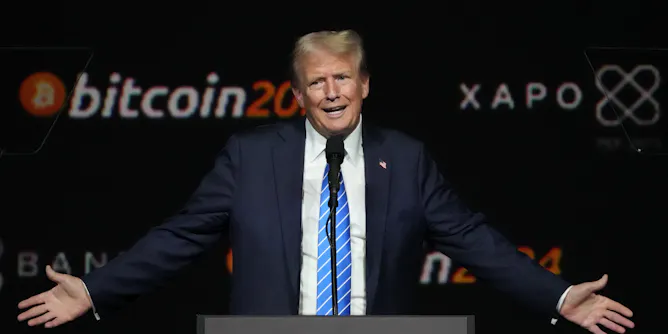
The crypto industry scored a series of wins in 2025, only to see its top legislative goal fail in 2026.
Articles on Stablecoins
Displaying all articles

Nigeria’s new Virtual Assets Council doesn’t close all the loopholes in crypto-asset regulation.

A recent ruling has clarified how one NZ dollar-backed crypto token fits within financial law. Just what does this mean for investors?
The rise in the use of stablecoins poses a risk of dollarisation across Africa.

Throughout history, control over money has been one of the most powerful levers of state authority. What does this mean in the new era of digital currencies?
Private banks are launching a euro-pegged cryptocurrency. It could spell disaster for Europe’s economy.

The legislation would allow corporations to issue their own ‘stablecoins’, which are essentially digital casino chips.

Central banks are now taking digital currencies seriously, and the EU is exploring the idea. While an “e-euro” could increase monetary security and stability, the venture is not without risks.

The UK economy could benefit from a digital pound, but is there a role for crypto?

Uncertainty is affecting what used to be the safer end of the market.

Stablecoins are less volatile, and considered a safer bet than many cryptocurrencies.
While cryptocurrencies have exploded in value, so has this sub-genre that mimicks real-world assets like the US dollar.

Decentralized finance makes it easier for virtually anyone to take advantage of financial markets without the need for a bank, but there are new risks as well.

Financial regulators are increasingly concerned about stablecoins, a type of cryptocurrency tied to an asset like the US dollar.

Operators like BlockFi and Nexo offer rates that are north of 9%.
Top contributors
-

Senior Lecturer in Business and Commercial Law, Lancaster University
-
Profesor Agregado de Economia, Universitat de Barcelona
-
Professor of Law, University of East London
-
Associate Professor of Finance, University of Oregon
-
Professeur de Comptabilité et Finance, Doyen Associé à la Recherche, ESC Pau
-
Lecturer in Computer Sciences at Gulf College, Oman, and PhD Candidate in Big Data, AI and Visualisation, Cardiff Metropolitan University
-
Lecturer in Finance, Cardiff Metropolitan University
-
Senior Lecturer in Economics, University of Otago
-
Senior Lecturer in Finance, University of Otago
-
Assistant Professor, Warwick Business School, University of Warwick
-
Director of Global Financial Markets Center, Duke University
-
Professor of Legal Studies and Business Ethics, University of Pennsylvania
-
Ascociate Professor in Finance, Audencia