
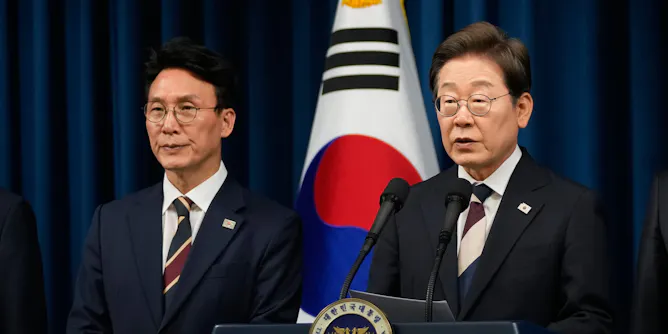
Lee Jae-myung’s election represents a turning point for South Korean foreign policy.
Articles on South Korea politics
Displaying all articles
Gender conflict subtly but powerfully shaped South Korea’s election.

Overshadowing almost everything in the country is the impeachment of the former president for abuse and the ensuing political paralysis.
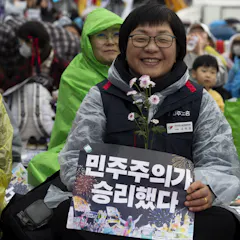
South Korea’s divided society will soon head to the polls to elect a new president.
Some women in South Korea are refusing to marry, have children, or engage in sexual relationships with men in response to deep-seated misogyny.
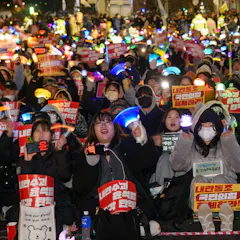
South Koreans demonstrating against President Yoon have turned protest sites into multi-coloured musical rallies.
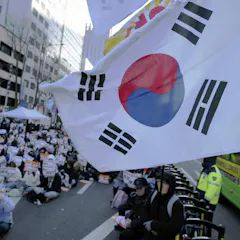
As trust in traditional media declines, populist influencers and journalistic ‘newsfluencers’ are gaining power.

After more than a week of political turmoil, South Korean lawmakers voted to impeach the country’s embattled president.
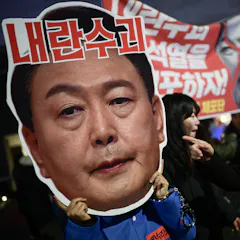
In 1972, a South Korean president instigated a self-coup and succeeded. Understanding why – and why the latest attempt failed – helps explain how far the country’s democracy has progressed and how fragile it could become.
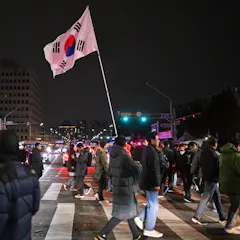
In the space of just a few hours, South Korea looked to be backsliding toward autocratic rule.
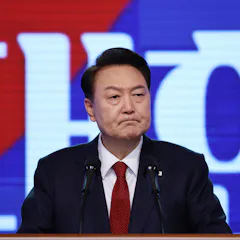
The South Korean leader seeks to strengthen ties with the US and Japan. But he might be hamstrung by domestic concerns.
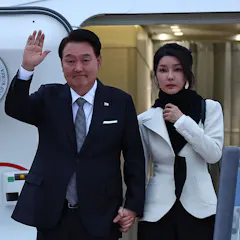
Heading into a parliamentary vote, there is very little gap between the ruling People Power Party and opposition Democratic Party – raising the prospect of a smaller party emerging as kingmaker.

South Koreans living away from home have been frequent targets for suspicion and ire during the pandemic. Some even report being shunned by their families.

Monsta X fans have been derided as boy-band dupes, but their protests against the treatment of superstar Wonho shows them rejecting the capitalist system that’s quick to cut people loose.
Top contributors
-

Assistant Professor, North Greenville University
-
Assistant Professor, Michigan State University
-
PhD Candidate in the School of Languages, Cultures and Linguistics, SOAS, University of London
-
Assistant Professor of History, Arizona State University
-
PhD Researcher, Centre for Media Transition, University of Technology Sydney
-
Postdoctoral Researcher, Discipline of Media and Communications, University of Sydney
-
Senior Lecturer in Korean Studies, University of Sheffield
-
Senior Lecturer in Korean Studies, University of Edinburgh
-
Research Fellow of East Asia Studies, Lund University; Australian Catholic University
-
Professor (Korean Society and Culture), Director of Korea Research & Engagement Centre, Curtin University
-
Assistant Professor, Department of English, Lakehead University
-
Professor of International Relations and Security, University of Bradford
-
Professeur des université - Sociologue, Université de Lille
-
Postdoctoral research fellow, Inrae