
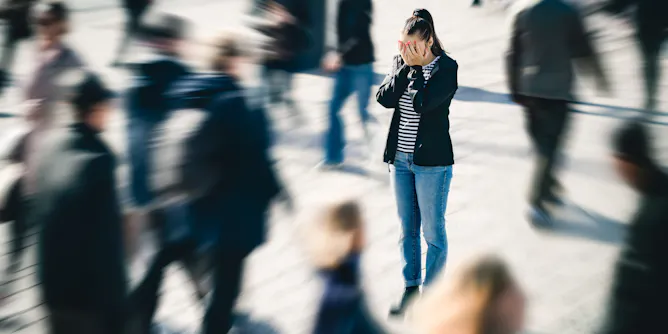
Our study suggests that socialising with acquaintances could trigger social anxiety more than close friends or strangers.
Articles on Social interaction
Displaying 1 - 20 of 45 articles
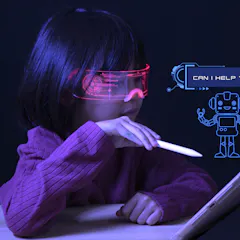
Young children’s brains develop through interaction with others. Throwing AI into the mix could make it more difficult for them to navigate real-world relationships.

A bit of understanding – plus effort to regulate yourself and give compassionate feedback – can shift a stuck relationship into something more bearable, perhaps even meaningful.
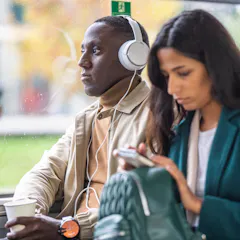
A social psychologist recommends ways to connect with others as you move through public spaces – with benefits for your own well-being as well as for the social fabric of your community.

Even after the pandemic lockdowns were lifted, out-of-home activities and travel remained substantially depressed, far below 2019 levels.

Will your aunt steal the show and make it all about her?

A lack of dopamine seems to directly cause social problems.

Laughter is so fundamental that animals like chimps, rats and dogs share the ability with humans. But in people it serves more serious social functions than just letting others know you’re having fun.
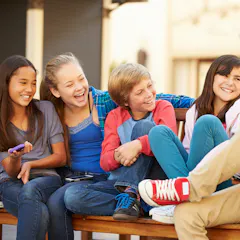
Too few friends or too many friends can hamper children’s learning and cognition.

Dancing requires physical, social and cognitive engagement and, as a result, it may bolster a wide network of brain regions.

Phubbing or ‘phone snubbing’ is when prioritise your phone over the people in your company – and it sucks. Here’s how to stop it.

Is it time for us to overhaul this longstanding symbol of social grace?

The presence of pets makes people seem more trustworthy, research has found. People are more likely to help a stranger with a dog or another pet than a person without one.
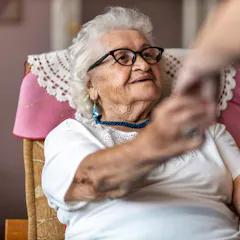
Keeping mentally, physically and socially active helps people with dementia maintain their brain and thinking. But in lockdown, when people with dementia did less, this can lead to a decline.

After more than a year of idealizing life without COVID-19, people are starting to reenter ‘normal’ life. Clinical psychology provides guidance on how to prepare for your post-pandemic reboot.

The duration of our conversations is rarely ideal – but that’s the price we pay for social solidarity.
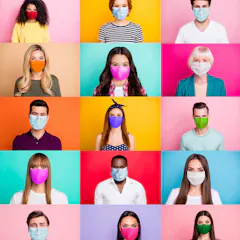
Wearing face masks hides our facial expressions and affects our social interactions. They make it harder for us to read facial expressions and can contribute to racist perceptions.

Neuroscientists tackling the age-old question of whether perceptions of color hold from one person to the next are coming up with some interesting answers.
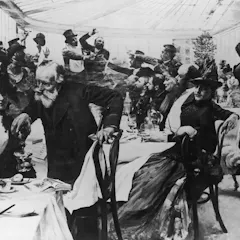
By missing out on chance encounters and observations that jolt ‘a-ha’ moments, new ideas, big and small, go undiscovered.

Recent findings from social neuroscience show us how we can make virtual interactions almost as beneficial as real world ones.
Top contributors
-
 Skye McDonald is a Friend of The Conversation.
Professor of Clinical Neuropsychology, UNSW
-
Lecturer in Psychology, King's College London
-
Lecturer in Social Psychology, University of Essex
-
Global Journalism Fellow, Dalla Lana School of Public Health, University of Toronto
-
Associate Professor of Psychology, University of Bath
-
Lecturer in Social Psychology, Loughborough University
-
Professor of Cognitive Neuroscience, King's College London
-
Senior Lecturer, Department of Psychology, University of Portsmouth
-
Postdoctoral Research Associate, Cognitive Neuroscience, University of Cambridge
-
Director, Office of Scholarly Communication and Publishing, University of Pittsburgh
-
Professor in Ageing and Health, University of Sydney
-
Assistant Professor of Psychology, Johns Hopkins University
-
Associate Director of Instructional Design, University at Buffalo
-
Associate Professor, ARC Centre of Excellence in Cognition and its Disorders & School of Psychology, The University of Western Australia
-
Reader of Psychology, University of Dundee