
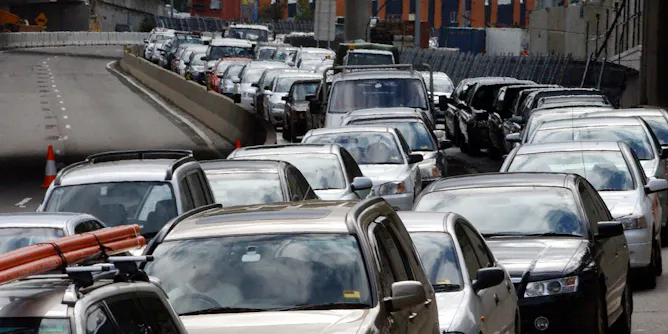
Projects like Sydney’s WestConnex and Melbourne’s Western Distributor don’t account for real world evidence of driver behaviour in estimating travel time savings.
Articles on Roads
Displaying 161 - 180 of 190 articles

Bigger cities increase wages, output and innovation, but also problems of congestion and pollution. Congestion charges can minimise these problems by dramatically improving traffic flows.
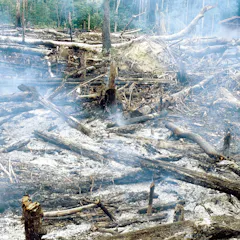
Big new investors such as the Asian Infrastructure Development Bank are key players in a worldwide infrastructure, and that could be bad news for the environment.
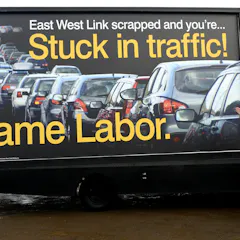
Poor project selection is undermining economic growth in Australia.
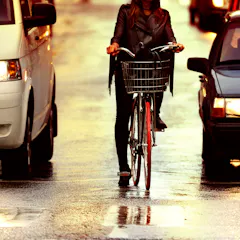
New South Wales’ new tougher bike laws reveal an ongoing war of the roads.
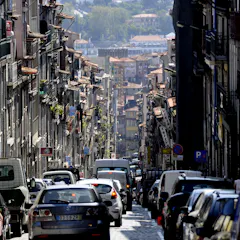
Would you take a longer route to work for the good of all?

Crews patch them, just to see these recurrent potholes come back again. New research focuses on microwaves zapping patches to make a more permanent pothole fix.

New data have revealed a disturbing trend in forest loss: the hearts of the world’s forests are disappearing. To stop them bleeding out, we’ll have to say ‘no’ to some developments.
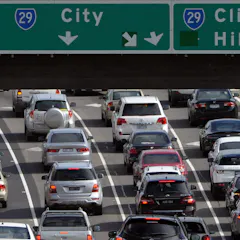
On average, people won’t accept a commuting time of more than an hour. As cities grow ever bigger, new road projects can’t achieve this, yet policymakers still rely on modelling that defies evidence.

Solar panels and roads — combining them just makes sense to help meet our clean energy needs, right? Maybe not quite.
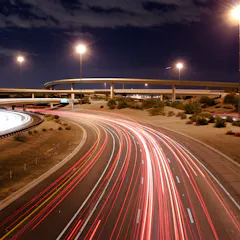
Self-driving cars may not be the solution to all our transport woes. Better to focus on public transport.
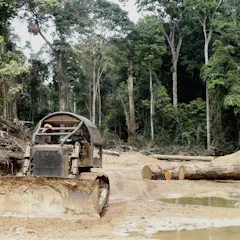
More than thirty gigantic infrastructure projects threaten Africa’s environment without offering economic benefits.

Allowing infrastructure to take over the job of keeping our vehicles running sends us further down a troublesome road.
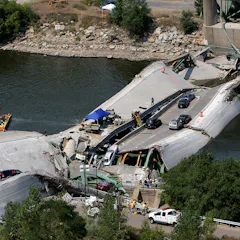
Our roads, bridges and schools are in dire need of aid, and the economic benefits of investment far outweigh the financial costs.
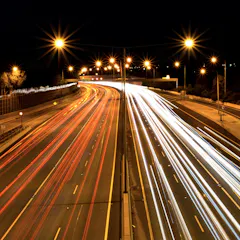
A research focus on transport can help improve existing infrastructure and guide future developments, and tailor them to Australia’s unique needs.

The longer Australia waits for reform to road use pricing, the more commuters will ultimately end up paying.
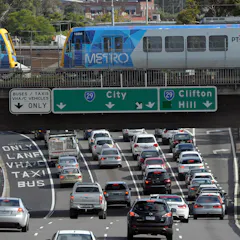
Once a new road opens, people switch back to cars and congestion increases back to a steady-state point of gridlock. For lasting effectiveness, policy needs to include congestion charges and better rail services.

The planning for any new road should include plenty of mathematical modelling. But getting the right numbers can be a challenge and there’s the odd paradox to deal with as well.
Amid talk of paths to surplus and investing in infrastructure, both sides of politics seem to have forgotten Australia’s longstanding responsibility to govern sustainably, and not just for the economy.

Across the western world, the distance people travel is starting to fall. That’s a good thing, for us and the environment.
Top contributors
-

Transport and Cities Program Director, Grattan Institute
-
Distinguished Research Professor and Australian Laureate, James Cook University
-
Associate Professor of Urban Planning, The University of Melbourne
-
Senior Lecturer in Urban Planning, University of Auckland, Waipapa Taumata Rau
-
Associate Professor in Infrastructure Management, University of Sydney
-
Associate, Grattan Institute
-
Researcher in Road Ecology, Nottingham Trent University
-
Honorary Professor of Transport Studies
-
Professor in Transport and Logistics Network Modelling, University of Sydney
-
Professor of Sustainability, Curtin University
-
Professor Emeritus of Global Change Biology and Terrestrial Systems Science, Oregon State University
-
Director, Centre for Western Sydney, Western Sydney University
-
Transport Fellow, Grattan Institute
-
Adjunct Associate Professor, University of Canberra
-
Professor Emeritus of International Environmental Policy, Tufts University