

Bringing employees back to work in person and smart office-based people management drives companies forward and is conducive to engineering change. Here’s how.
Articles on Return to office
Displaying all articles
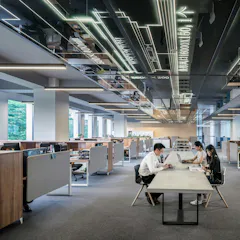
Many employees say they prefer flexibility when it comes to working in the office, but they find it creates uncertainty and unpredictability.

Companies have a lot to gain from implementing external corporate innovation programs such as sending their employees on work placements in open labs.

For many women, going back to the office can mean stepping back into environments where gender bias is more pronounced.

Remote-work flexibility has supported workplace equity helped limit outbreaks of respiratory infections. Back-to-offices mandates could erase those gains, especially with lowered vaccination rates.

Companies are betting on office mandates to fix sluggish productivity, but what workers need most are affordable homes, shorter commutes and real opportunities to grow, not added stress.

That’s a huge change from 2019, when remote work accounted for only 7% of the nation’s paid workdays, even if it’s a big decline from 2020.

The message is clear: the push to get workers back into the office is being incorporated into US government policy. Here’s what could be lost.

Workplace friendships have many benefits – but they can also be as difficult as any relationship. Guarding against complacency and not taking each other for granted can go a long way.

A survey of more than 500 Australian organisations found workers are prepared to take a pay cut rather than return to the office.

Instead of trying to force unwilling workers back to the office, Canadian cities should instead focus on developing downtowns that people genuinely want to visit and experience.

COVID-19 transformed the workforce, including in the public sector. A complete reversal to pre-pandemic work models is unlikely, but there’s lots at stake as employers contemplate the future of work.
Top contributors
-

Professor of Management and Organizational Leadership, Drake University
-
Professor of Information Management and Business Analytics, Drake University
-
Professeur agrégé, École d'études politique, Directeur, Centre d'études en gouvernance / Associate professor, School of Political Studies, Director, Centre on Governance, L’Université d’Ottawa/University of Ottawa
-
Professor of Geography & Environmental Studies, Wilfrid Laurier University
-
Director, Urban Development Program; Professor, Geography & Environment, Western University
-
Research scientist, Western University
-
Professor, Department of Epidemiology and Biostatistics; Professor, Department of Paediatrics; Professor, Brescia School of Food and Nutritional Sciences, Western University
-
Professor of Management, Deakin University
-
Senior Lecturer in Innovation and Entrepreneurship, University of Auckland, Waipapa Taumata Rau
-
Professor of Human Resource Management, Head of School of Management, Curtin University
-
Research Fellow in Sociology, Concordia University
-
Professor of Sociology, University of Alberta
-
PhD Candidate, Sociology, University of Alberta
-
Professor of Sociology, University of Alberta
-
Professor of Strategic Management, University of Toronto