
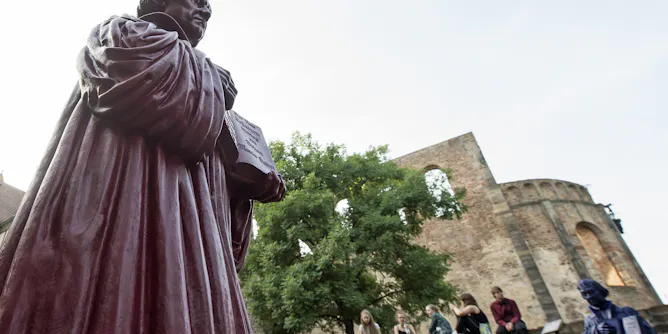
On Oct. 31, 1517, a German monk, Martin Luther, started the Protestant Reformation. Its impact went far beyond the split in the Church that most people are familiar with.
Articles on Reformation 500
Displaying all articles

In the early 1900s, a group of Protestants in the US attempted a reunion of Christianity. They failed, of course, but they prompted a new dialogue.

As well as his 95 Theses, Luther took on the awesome challenge of a new German translation of the Bible in which he set out to challenge both doctrinal and social beliefs.

In the great reformer’s eyes, if you didn’t love a rousing tune you deserved only “the music of the pigs”.

Just what are we celebrating when we imagine an Augustinian friar nailing a document to a church door?
University degrees perform the same function in 2017 as indulgences did in 1517.

Martin Luther has always given the country a chance to examine itself. Half a millennium on, the picture is more complex than ever.

On the 500th anniversary of the Protestant Reformation, two scholars explain how Luther’s personal and spiritual life contributed to his success.

Meet Jakob Fugger, the man who underwrote the ambition of power-hungry medieval Princes.

Luther translated the Greek New Testament into a common German dialect that ordinary people could read, without help from clergy.
Top contributors
-

Professor of History, University of Warwick
-
Associate Professor, University of Leicester
-
Chancellor's Professor of Medicine, Liberal Arts, and Philanthropy, Indiana University
-
Emeritus Professor of Early Modern History, University of Sheffield
-
Director of the Reformation Studies Institute, University of St Andrews
-
Researcher in English and Biblical Studies, University of Sheffield
-
Associate Professor of Intellectual Heritage, Temple University
-
Professor Emeritus, University of Oregon
-
Professor, University of Washington
-
Commissioning Editor, Health + Medicine and Host of Strange Health podcast, The Conversation
-
Senior Lecturer in Early Modern History, University of Birmingham
-
Auguste Comte Chair in Social Epistemology, University of Warwick