
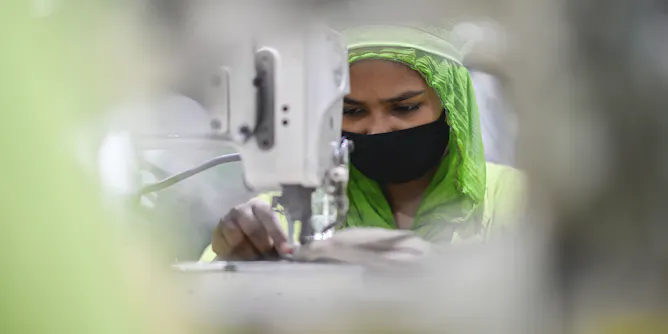
An innovative new strategy to address gender-based violence and harassment is showing promising early signs of effectiveness, but these gains are being undermined by ‘America First’ policies.
Articles on preventing gender-based violence
Displaying all articles

Domestic violence is not a random event. New research indicates most men who perpetrate domestic violence have contact with police well before they are charged with a domestic violence crime.

Everyone — from academics to policymakers to the public — needs to think about how we can address toxic beliefs to create long-lasting change and foster safer online communities.

Committing resources to violence prevention and services for victims/survivors is necessary to meet current and future needs.

Publishing the faces and names of people accused of violence isn’t the best way of getting them to change their behaviour.

New technologies lead to new forms of gender-based violence such as cyberflashing, where survivors receive unsolicited explicit images. There is a need for legal and societal responses in response.

Survivors of gender-based abuse can often feel retraumatized by the justice system. But simple acts of validation and support can make a meaningful difference and restore a sense of agency.

Increases in intimate partner violence have highlighted the need for creative and innovative ways of addressing the issue, particularly during emergencies.

Faculty and university staff are embedding training to prevent gender-based and sexual violence into curricular goals of both arts and STEM classes.
Top contributors
-

PhD, Political Science, Western University
-
Professor, Family Studies, Mount Saint Vincent University
-
Professor, Department of Criminology, Saint Mary’s University
-
Research Fellow, Australian National University
-
Assistant Professor, Global Development Studies, Queen's University, Ontario
-
Professor, Faculty of Social Work & Director, RESOLVE (Research and Education for Solutions to Violence and Abuse), University of Manitoba
-
PhD Candidate in Sociology, Dalhousie University
-
Research Technician at RESOLVE (Research and Education for Solutions to Violence and Abuse), University of Manitoba
-
Assistant Professor, Gender & Social Justice, Trent University
-
Canada Research Chair in Inequality and Gender, Western University
-
Associate Professor of Interdisciplinary Studies, Royal Roads University
-
Lecturer, School of Computing Technologies, RMIT University
-
Assistant Professor in Media and Digital Cultures, University of Groningen
-
Associate Professor, Brenda Strafford Chair in the Prevention of Domestic Violence Faculty of Social Work, University of Calgary
-
Distinguished SFU Professor of Global Supply Chain Governance, Simon Fraser University