
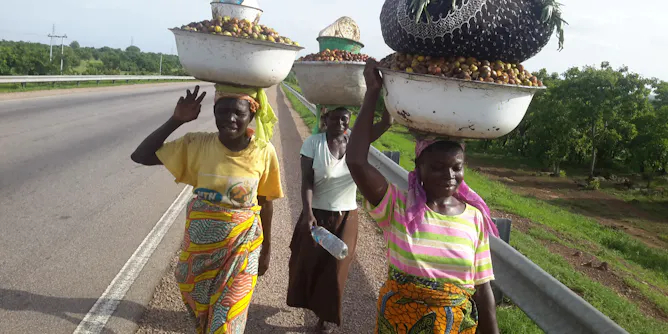
Shea is a key economic crop for poor women in the northern parts of Ghana.
Articles on Policy
Displaying 41 - 60 of 188 articles

With its IPPO partners, The Conversation is addressing some of the biggest policy challenges.

Setting guidelines for human coexistence with carnivores usually falls to local community leaders. An expert explains why the federal government should step in.

You can affect how legislators vote, but you can’t just fire off a nasty email and expect them to listen to you.

Ghana is a signatory to several international conventions that oblige it to guarantee the right to life.

Sex-based policies can lead to backlash and further discrimination in the workplace.
Zambia has progressively incorporated green-based policy interventions since the 1960s.

Improving the ability for worker’s voices and perspectives to be heard in the workplace could have wide ranging benefits for employers and broader society at large.

Over the coming weeks, IPPO will publish a series of evidence reviews commissioned to get to the heart of the major social questions facing policymakers in the wake of the pandemic.

A new environment calls for new approaches to policy-making that can more effectively navigate the complexities of today’s world.

Ghana’s government should shift to a community-based and voluntary approach to forest restoration and conservation

In Africa, French will only continue to embed itself - if speaking it is in the interests of Africans and not attached to French foreign policy interests.

Nigeria’s banking sector is dominated by local players born out of state policy.

Flood risks are rising as the climate warms. The risks are complex, as a levee or new roadway in one place can worsen flooding somewhere else.

Here’s how the government can provide clarity on the volatile cost of living crisis

British households waste nearly 32% of all purchased food items per year.

In a new report, child family violence survivors describe how family court worsened their trauma and profoundly affected their well-being even into adult life.

Industries have blocked or delayed new regulations and pushed to remove or dilute existing regulations by framing regulations as detrimental to creating jobs and wealth.

As long as industrial policies in Nigeria are introduced only as a crisis response, import restrictions will continue to be their focus.

The large budgets allotted for urban policing must be reconsidered so that communities can explore safer alternatives.
Top contributors
-

Senior Research Fellow, University of Edinburgh
-
Professor, Public Service Research, UNSW
-
Director of Research and Development, Pivot Professional Learning; and Honorary Fellow, The University of Melbourne
-
Professorial Fellow, University of Canberra
-
Professor of Economics, University of Technology Sydney
-
ESRC Strategic Adviser on Quantitative Methods Training, University of Edinburgh
-
Professor of Economics, Department of Economics, Deakin Business School and Alfred Deakin Institute for Citizenship and Globalisation, Deakin University
-
Professor of Economics, USC Dornsife College of Letters, Arts and Sciences
-
Emeritus professor, School of Regulation and Global Governance, ANU, Australian National University
-
Associate Professor of History, Miami University
-
PhD Candidate in Social Policy, University of Kent
-
Professor & Greenbaum/Ferguson/NJAR Endowed Chair in Real Estate Policy, Monmouth University
-
Professor, University of Sydney; RMIT University
-
Visiting Fellow, Faculty of Asian Studies, Australian National University
-
Senior Fellow, National Centre for Indigenous Studies, Australian National University