
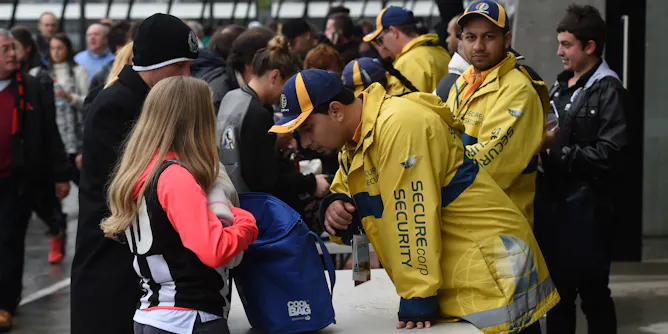
The legal status of private security staff is, for the most part, decidedly uncertain.
Articles on Policing
Displaying 321 - 340 of 376 articles
Police are important, but not sufficient, in the crime-reduction effort. I have enormous faith in their abilities, but that doesn’t necessarily mean we need more of them.

As Queensland considers new laws to curb alcohol-fuelled violence in response to a one-punch death, several policy experiments that have occurred in recent years can provide valuable lessons.

More than 1,000 people have been killed by police in the US this year alone. Unlike the officer who shot Laquan McDonald, few are ever charged.

American police kill 100 times more civilians than Finnish police. Racism and gun control are just part of the problem.

Preventing crime before it happens, while saving resources, sounds like a great use of big data. But these calculated probabilities raise big questions about civil liberties.
There’s a surprising amount of resistance to making policing a graduate profession.
Aboriginal people with mental and cognitive disability are managed mostly by police, courts, prison and hospitals. It’s costing us millions, when kinder and cheaper alternatives exist.

Police have become the default frontline response to Aboriginal people with mental and cognitive disabilities, setting this group up for a lifetime of ‘management’ by the criminal justice system.

Research suggests serious problems with the way Aboriginal women, particularly those with mental and cognitive disabilities, are “managed” by the criminal justice system.

Australia’s high rates of imprisonment and re-imprisonment of Aboriginal people with mental and cognitive disabilities is not only shameful, it is entirely predictable and preventable.

We cannot ignore or underestimate the important role police can play in community-based efforts to tackle radicalisation and violent extremism.

Police brutality is an ongoing problem in South Africa. Police-worn body cameras may help reduce such incidents by improving accountability. They may also contribute to the safety of officers.

The Internet Watch foundation is to share its database of abusive image digital signatures in a drive to clean up the internet.

Math isn’t prejudiced, goes the argument. But these arithmetic programs can learn bias from the data fed into them by human beings, leading to unfair treatment and discrimination.

Two criminologists long associated with the University of Missouri – St Louis dispel myths about Ferguson, a community that borders the campus, and explain what’s behind the violent protests there.
Police in Lowell, Massachusetts and Memphis, Tennessee are using a new approach designed to help them build trust while enforcing the law.

It has been 10 years since British police shot and killed an innocent man in Stockwell station.

Groups like Letzgo Hunting claim to fill the gaps left by inefficient police work, but does their approach undermine police work and treatment?
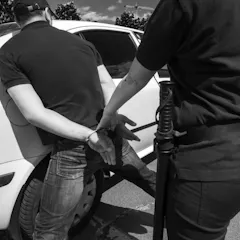
Northern Territory police powers to make ‘paperless arrests’ are completely contrary to recommendations by the Royal Commission into Aboriginal Deaths in Custody, and now the inevitable has happened.
Top contributors
-

Associate Professor in Criminal Justice and Criminology, Bond University
-
Professor of Law, University of Technology Sydney
-
Assistant Professor of Criminal Justice and Criminology, Georgia State University
-
Emeritus Professor in Law and Criminal Justice, Adelaide University
-
Senior Lecturer in Law, UNSW
-
Associate Professor, UNSW
-
Assistant Professor, Augusta University
-
Professor (Practice), Faculty of Business and Economics, Monash University
-
Professor Emerita of Criminology, UNSW
-
PhD Candidate in Social Work and Criminology, UNSW
-
Professor, Sociology, University of Alberta
-
Professor of Criminology, University of Leeds
-
Eleanor Rathbone Chair of Sociology, University of Liverpool
-
Assistant Professor of Criminology and Criminal Justice, University of South Carolina
-
Associate Professor in Law, University of Canterbury