
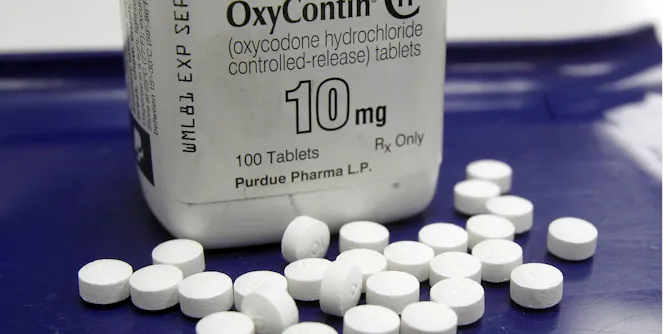
OxyContin maker Purdue has reportedly been mulling a bankruptcy filling, just as the first of around 2,000 lawsuits against it prepares to go to trial.
Articles on Opioids
Displaying 141 - 160 of 222 articles

A safety committee convened by the FDA has declared esketamine safe for severe depression. But isn’t this drug the same as ketamine, an illegal street drug? A medical anthropologist explains.

The over-medicalization of back pain is a global concern. New research in Canada shows that people with lower income as well as rural and remote dwellers are less likely to access physiotherapy care.

Drinking among older adults is up. And while overdrinking may not pose an immediate threat of overdose, it is not healthy for seniors, many of whom take several medications and are at risk for falls.

The sexualized use of crystal meth by gay men is one of the key drivers of rising HIV rates and has many negative mental health consequences. Integrated sexual and substance use care is vital.

People who use painkillers for non-medical reasons often justify it as a form of self-medication for legitimate medical diagnoses such as depression, anxiety and stress.

Many people may misunderstand the basics about opioids. That prevents researchers from understanding the full scope of the epidemic.

Naloxone programmes have sprung up in the UK and elsewhere, but drug death rates keep climbing.

Did you know that trauma, even when there is no tissue or nerve damage, can cause chronic pain? Exactly how much pain and who is most vulnerable depends on which ‘stress genes’ we carry.

Many people aren’t just taking one drug but a combination of drugs.

The opioid crisis in the US has quadrupled the number of babies born addicted to drugs.

The US opioid epidemic killed more than 40,000 people in 2016 – now, other countries are at risk.

There are proven ways to reduce drug deaths. Unfortunately, the UK government is not implementing them.

Big Pharma in Canada is far behind the curve when it comes to disclosing what payments to health-care professionals are for.

Most countries need to find a happy balance between the American attitude that all pain needs to be cured – and the ethos in other countries that pain is to be endured.

Scientists have taken atomic resolution snapshots of an opioid receptor interacting with a drug. Now they are using these images to design “biased” opioids that block pain without the dangerous side effects.

The obesity epidemic, the flu epidemic, the opioid epidemic… in the 21st century, everything seems to be an “epidemic”. But what does the term actually mean?

Each person experiences pain differently, depending on his or her genetic makeup. That makes it difficult to figure out what treatments patients need.
Scientists are just starting to understand how your parents’ genes and experiences might shape your own susceptibility to dangerous drugs. Could that help to stop addictions before they start?

Prescription drugs are policed by industry and Health Canada has never prosecuted a drug company for illegally marketing a drug.
Top contributors
-

Professor and Deputy Director, Monash Addiction Research Centre, Monash University
-
Professor, Institute for Musculoskeletal Health, University of Sydney
-
Professor of Neuropharmacology, University of Lancashire
-
Associate professor, Department of Family and Community Medicine, University of Toronto; York University, Canada; University of Sydney
-
Professor, Sydney School of Public Health, University of Sydney
-
Medical Director of Opioid Policy Research, Brandeis University
-
Professor of Geography, Penn State
-
Associate Professor of Sociology, Bentley University
-
Associate Professor of Emergency Medicine, Thomas Jefferson University
-
Adjunct Professor at the National Drug Research Institute (Melbourne based), Curtin University
-
Honorary Fellow, Department of Health Sciences, University of York
-
Associate Professor, School of Public Health, University of Sydney
-
Professor of Law, Indiana University
-
Senior Lecturer in Criminology, UNSW
-
Professor, National Drug Research Institute, Curtin University and Burnet Institute, Burnet Institute