
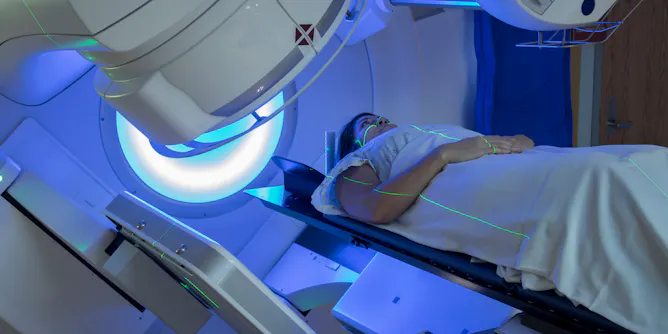
Higher doses of radiotherapy for cancer treatment destroy more healthy tissue as well as more tumour cells. Gold nanoparticles sensitize tumours to radiation, making treatment more effective.
Articles on Nanoparticles
Displaying 21 - 40 of 61 articles
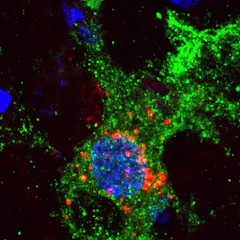
These tiny nanoparticles might provide a new way to see what’s happening in the brain and even deliver treatments to specific cells – if researchers figure out how to use them safely and effectively.

Nanoparticles are extremely tiny particles, with external dimensions smaller than 100 nanometres (0.0001 of a millimetre). Here’s what we know about nanotechnology in food.
A PhD student in chemistry addresses some of the most common misconceptions about chemistry.
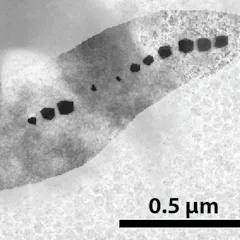
These single-celled organisms naturally respond to the Earth’s weak magnetic field. Scientists are untangling how it all works, looking to future biomedical and other engineering applications.
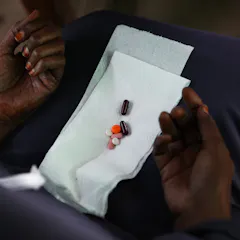
The reason that nanoparticles hold such hope for TB treatment is that they can be carefully targeted.
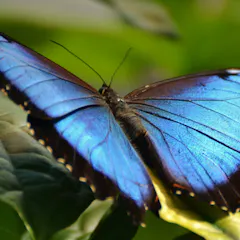
There are countless nanoscopic architectures in nature, creating iridescence, sticky feet, magnetic navigation – and more.
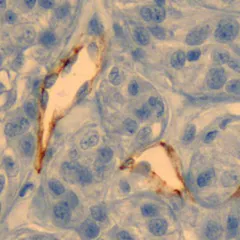
Gold can be used to make jewelry, but also to fight cancer. Several clinical trials are currently underway in the United States where patients are being treated with gold nanoparticles.
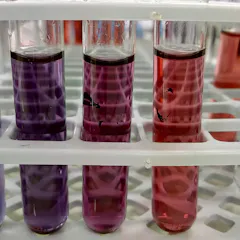
Nanotechnology brings together multiple science disciplines to create devices that mimic the refinements of nature. It’s difficult – and exhilarating.

Less-toxic hair dye would be a great invention. But discounting the risks that come with nanoparticles could undermine other efforts to protect human health and environmental from their effects.
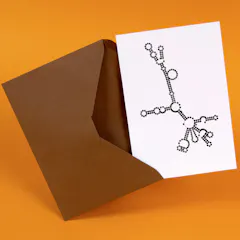
One big challenge for gene therapies is delivering DNA or RNA safely to cells inside patients’ bodies. New nanoparticles could be an improvement over the current standard – repurposed viruses.
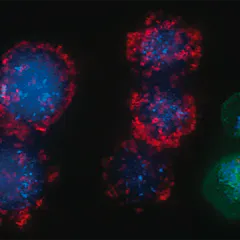
The more we learn about bio-nano science, the easier it will be to design nanoparticles that behave like we want them to.
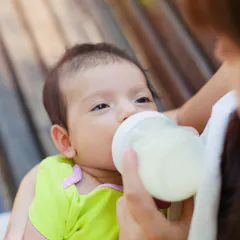
A widely publicised study that cast doubt on the safety of milk formula was misleading, based on dubiously reported studies and may have serious consequences.

Coating paper with an inexpensive thin film can allow users to print and erase a physical page as many as 80 times. That reduces both the cost and the environmental effects of paper use.

The advent of electron microscopy and nanobiology has moved our appreciation of the living world to unprecedentedly small scales – with entirely new benefits and potential pitfalls to consider.

From the kitchen sink to the laundry and garage – nanotechnology has already made its way into the average household.
Tastier salt, packaging that alerts you to food that has gone off and fish oil that tastes better – nanoparticles have lots of potential.

Two new studies from Food Standards Australia and New Zealand show there’s no evidence that nanoparticles in food present a health risk, but there’s more research to be done.
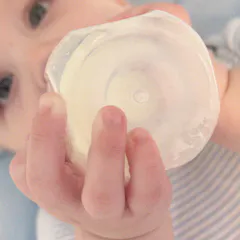
Microscopic needle-like particles don’t seem like something you’d want to feed a baby. Whether safe or not, the way we deal with nanoscale food additives leaves plenty of other questions.
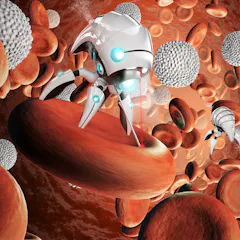
A single-atom engine is the latest example of how nano-technology can create machines to power tiny robots inside the body.
Top contributors
-

Professor of Advanced Technology Transitions, Arizona State University
-
Associate Professor, Pharmaceutical Sciences, University of the Western Cape
-
Postdoctoral Fellow, Nanotechnology, Carleton University
-
Professor & Chair in Air Quality and Health; Founding Director, Global Centre for Clean Air Research (GCARE), Co-Director, Institute for Sustainability, University of Surrey, University of Surrey
-
Associate Professor of Immunotoxicology; Co-ordinator of Nanosafe Australia and Asia Nano Safe research networks, RMIT University
-
Soil Scientist, Australian Centre for International Agricultural Research
-
Postdoctoral fellow, University of South Africa
-
Doctoral Student in Biochemistry, University of Washington
-
Lecturer in Robotics, University of Bristol
-
Postdoctoral research assistant, University of Sheffield
-
PhD candidate, UNSW
-
PhD Candidate in Chemistry, McGill University
-
Professor of Engineering Science, University of Oxford
-
Senior Lecturer in Pharmacology, Adelaide University
-
Professor of Chemical Engineering and Chemistry, University of Sheffield