
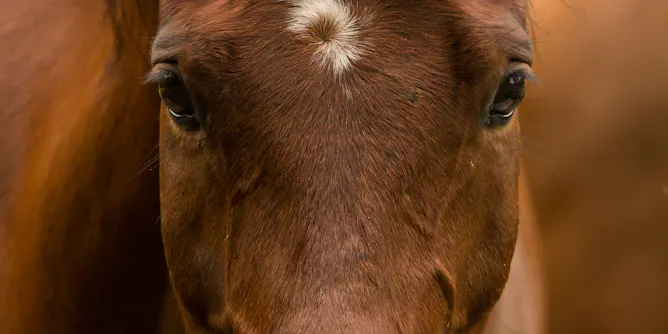
It also explains why there are exceptions to the rule – including humans, who have strikingly short faces relative to the braincase.
Articles on Morphology
Displaying all articles
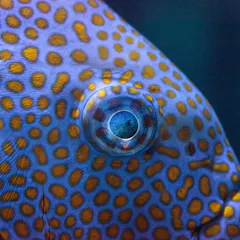
Understanding how the intricate spots and stripes, or Turing patterns, of many animals form can help scientists mimic those processes in the lab.
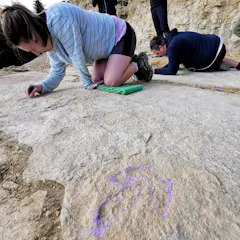
Collectively, the evidence studied by ichnologists helps to paint a picture of long-gone landscapes and the creatures and plants that populated those spaces.

While we know that most chameleons have such a prehensile tail, it’s not yet clear how it works and what makes it simultaneously so flexible and strong.
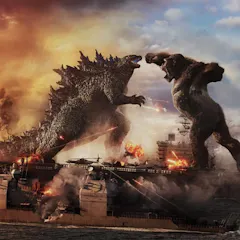
Hollywood loves a good monster battle, and where better to turn for inspiration than the animal kingdom? Traits from real animals can provide clues about the fighting prowess of Kong and Godzilla.
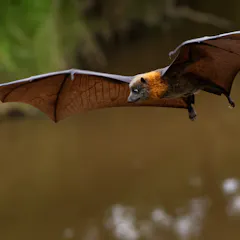
Echolocation evolved multiple times in bats over millions of year. Yet the earliest bat ancestors probably didn’t have this skill — or if they did, it was likely very primitive.
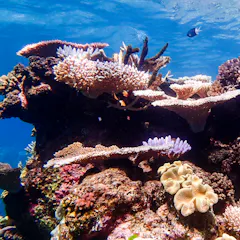
There are fundamental knowledge gaps around coral in the Great Barrier Reef, including how many species live there and where they’re found. Our new study finally starts to fill those gaps.

Global long-term data simply doesn’t exist for jellyfish, so scientists struggle to predict, track and mitigate their potential effects.
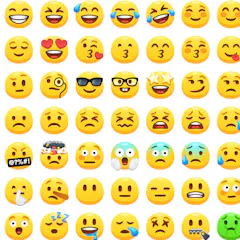
The conventions used in texting and tweeting are fundamentally altering how people communicate, but many language apps still rely on old-school English-language grammar.
Top contributors
-

PhD candidate, University of the Western Cape
-
PhD in biology, Ghent University
-
Vertebrate Paleontologist, Rutgers University
-
Senior Research Fellow, James Cook University and Senior Curator of Corals, Queensland Museum, James Cook University
-
Senior Research Fellow in Ecology & Evolutionary Biology, Adelaide University
-
Postdoctoral Fellow, Flinders University
-
Research Zoologist and Curator of Corals, Smithsonian Institution
-
Assistant Professor of Chemical and Biological Engineering, University of Colorado Boulder
-
Professor, Australian National University
-
Postdoctoral fellow, University of Toronto
-
Researcher and curator, Jurassica Museum
-
Senior Research Fellow in Ecosystem Dynamics, James Cook University
-
Professor, Multilingual Education and Associate Dean, Research, York University, Canada
-
Professorial fellow, James Cook University
-
Professor in Evolutionary Biology, College of Science and Engineering, Flinders University