
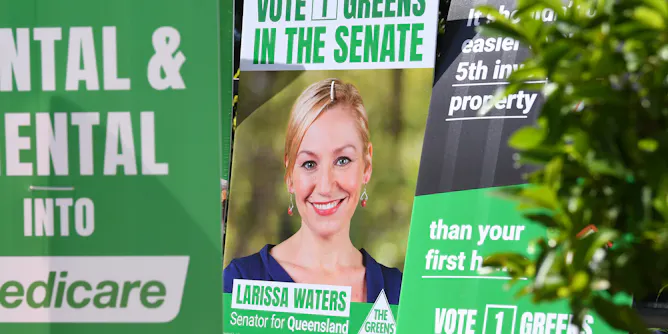
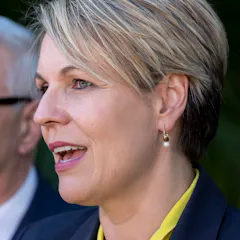
With the Liberals’ 2025 election review recently leaked, what does the Greens’ version reveal about the lessons they’ve taken from the federal poll?
Articles on Minor parties
Displaying 1 - 20 of 27 articles
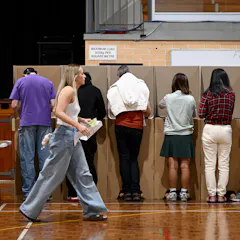
While minor parties lost seats this election due to preferences, their primary vote is the highest ever. This is largely due to voters’ frustration with poor economic management.
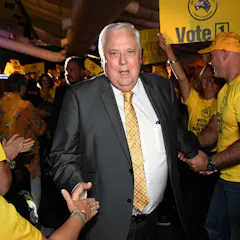
An expert on populism gives 6 reasons why these minor parties failed to gain electoral success.
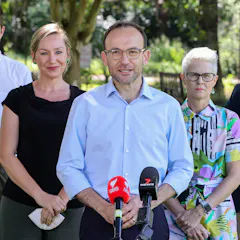
The Greens and Labor have a mixed record of working together, but can learn from past experience.
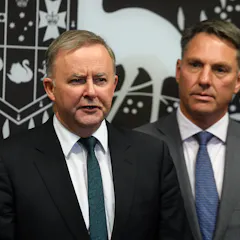
Notionally, Labor will need a 0.6% swing to win the next election. But the details make it much more complicated - and difficult.
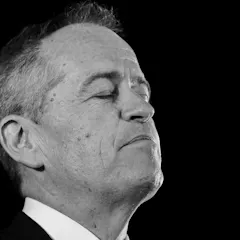
Election data suggests the Coalition’s victory wasn’t so surprising after all – long-term trends pointed toward a Labor loss, given the various factors in play in this election.
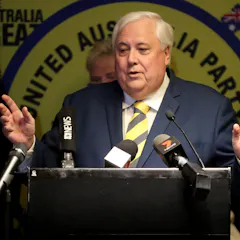
Especially in Queensland, right-wing populist parties like One Nation and United Australia Party had a significant impact on how seats played out, and especially taking votes from Labor.
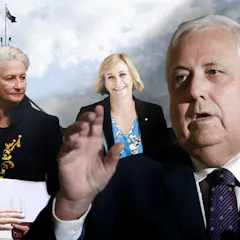
Voter dissatisfaction with the major parties means minor party preferences are likely to play a critical role in many seats, making the election outcome hard to predict.

It’s been 27 years since our last recession. Conditions are ripe for a populist revolt when the next one arrives.
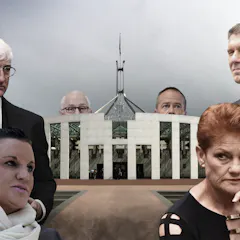
Ahead of Saturday’s crucial byelections, senior Labor Party figures have described a vote for Pauline Hanson’s One Nation party as a vote for the Coalition. What do the records show?
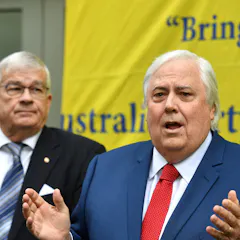
Clive Palmer believes he can recapture the magic that saw him elected to Parliament in 2013, but what his new party – and others on the right – need is more discipline.
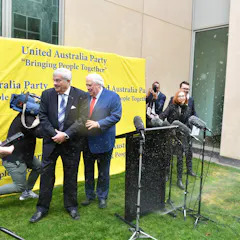
Any voters so angry about the more conventional parties that they are tempted to look Palmer’s way again might like to consider the shenanigans on Monday.
The recent elections in Tasmania, South Australia and the byelection in Batman have left an impression that the advance of the minor parties has stalled. This is not necessarily the case.
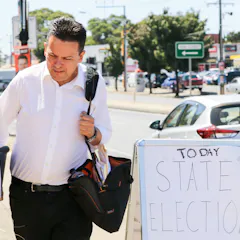
The minor party vote in Australia is historically high and growing, as trust in the bigger parties slides away.
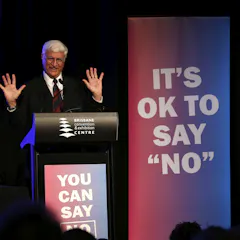
The ‘yes’ vote disproves that the rise of the minor party vote is the result of a cultural backlash from people who reject the progressive agenda, including the expansion of rights for minorities.
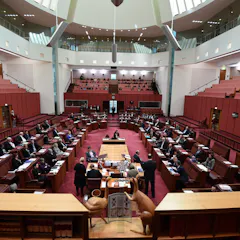
The new Senate is representative of the wide range of views in Australia – and far more so than the House of Representatives.
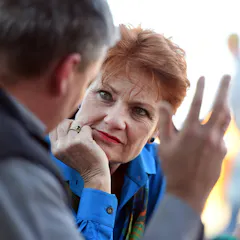
Watch Anne Tiernan and Duncan McDonnell discuss the popularity of minor parties and independents in this election – including what the Nick Xenophon Team learnt from the Palmer United Party.
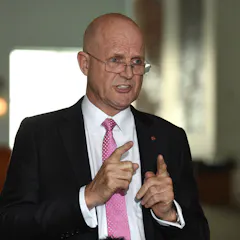
Liberal Democrat senator David Leyonhjelm says the government has been appallingly bad at negotiating with the crossbench.
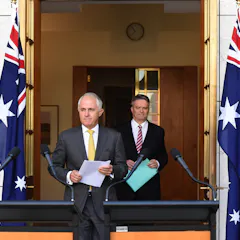
What are the government’s proposed changes to the way the Senate is elected? And how will they affect us as voters?
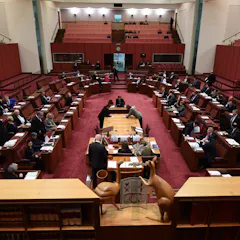
Those who do understand the Senate voting system have the potential to wield some influence both in its conduct and in debates about how it might be reformed.
Top contributors
-

Senior Lecturer, School of Political and Social Inquiry, Monash University
-
Senior Lecturer, Department of Languages and Linguistics, La Trobe University
-
Chief executive officer, Grattan Institute
-
Election Analyst (Psephologist) at The Conversation; and Honorary Associate, School of Mathematics and Statistics, The University of Melbourne
-
Professorial Fellow, University of Canberra
-
Associate, Grattan Institute
-
Lecturer, The University of Queensland
-
Senior Lecturer, Department of Government and International Relations, University of Sydney
-
Emeritus Professor, Musashino University
-
Industry Professor, University of Technology Sydney
-
Partner, Government & Public Sector, Providence / Honorary Fellow, Australian National University
-
Professor, the McKinnon Institute for Political Leadership, Monash University
-
Senior research fellow, The University of Melbourne
-
Principal Research Fellow, Melbourne Institute of Applied Economic and Social Research, The University of Melbourne
-
Professor of Politics, Griffith University