
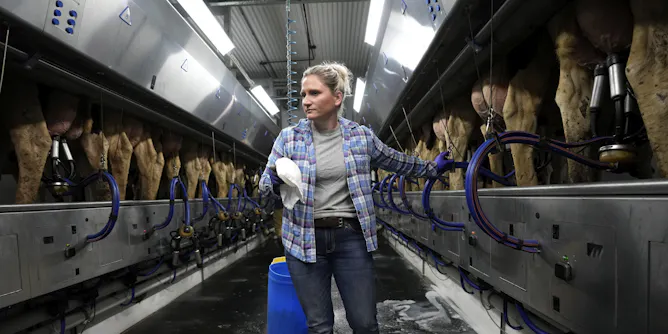
Dairy farms are struggling to survive as production costs exceed sales. The result, consolidation, with more cows on bigger farms, has an impact on communities and knowing where your food comes from.
Articles on Milk prices
Displaying all articles

Pressure is mounting on Australia’s dairy farmers, from farm gate prices to animal welfare concerns, and technology that could produce milk without cows.

Dairy farmers’ incomes are dependent on so much more than the retail price of fresh milk.
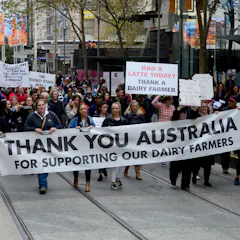
Calls to boycott supermarket-branded milk are misguided; and a royal commission into treatment of dairy farmers would be money wasted.

Coles plans to compete with competitors by moving away from low prices to a focus on other attributes, such as sustainability, local produce and community.
Government intervention in the crisis facing Australian dairy has opened the gates for suggestions of other types of regulation.

Agriculture Minister Barnaby Joyce has announced a package of concessional loans and facilitation of access to assistance for the beleaguered dairy industry.
The break up of trust between dairy farmers and Murray Goulburn can be tracked back to the degregulation of the dairy industry.
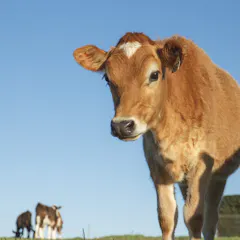
The dairy industry faces a number of welfare issues, and is a major contributor to greenhouse gases.
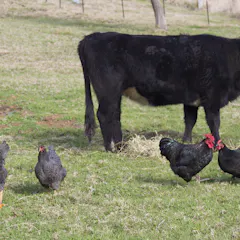
Two of the largest dairy cooperatives have been playing with farmers by pursuing a high price for milk when both should have taken into account fluctuations in the global dairy markets.

Cooperatives like Murray Goulburn and Fonterra and dairy farmers need to accept that lower milk prices will be the new normal in a more competitive global market.
Top contributors
-

Professor of Dairy Production Systems, Te Kunenga ki Pūrehuroa – Massey University
-
Sir Graeme Harrison Professorial Chair in Global Value Chains and Trade, Lincoln University, New Zealand
-
Professor of Marketing and Consumer Behaviour, Queensland University of Technology
-
Senior Lecturer, School of Management, Te Kunenga ki Pūrehuroa – Massey University
-
Professor of History and Egg Farmers of Canada Chair in Public Policy, University of Waterloo
-
Winthrop Professor, Entrepreneurship, Innovation, Marketing and Strategy, The University of Western Australia
-
Professor of Cattle & Sheep Production Medicine, The University of Melbourne
-
Scientia Professor of Economics, UNSW
-
Associate Professor of Animal Science and Dairy Extension Specialist, University of Tennessee
-
Associate Professor of Marketing, Tasmanian School of Business and Economics, University of Tasmania
-
Professorial Fellow, University of Canberra
-
Historian, The University of Melbourne