
Countries like North Korea and Russia are developing ever-more sophisticated tactics to dodge sanctions enforcement. Listen to The Conversation Weekly podcast.
Articles on maritime trade
Displaying all articles
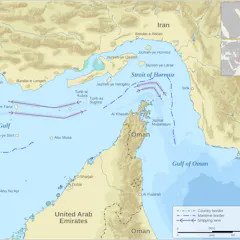
As the Strait of Hormuz reopens, a new study reveals what the agri-food industry’s priorities should be to overcome such an unprecedented logistical challenge.
The Caspian Sea has enabled Iran and Russia to supply each other with weapons and trade goods despite western sanctions.

Iran has warned it could close down the strait, through which 20% of the world’s oil transits each day.

The agreement labor leaders and management reached will suspend the strike until at least Jan. 15, 2025. There will be more time for additional collective bargaining and negotiations.
Recent tensions between the US and China can be explained by the geopolitics of sea power and the geography of near and far waters.
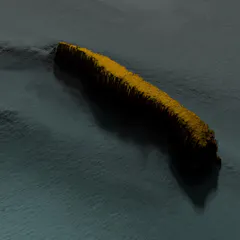
The SS Hartdale was sunk by a German U-boat in 1915 and its final resting place had long been unknown.

Southeast Asian leaders have made clear their priorities this week. Some want more focus on climate change than geopolitical competition.

The South China Sea is of strategic and economic importance to Beijing and the US, setting up a potential power struggle that could spark conflict.
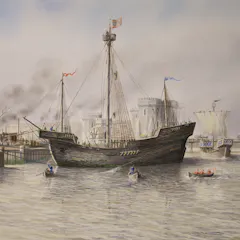
The Newport medieval ship is the most complete section of a 15th-century European vessel discovered to date.
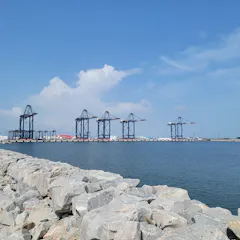
Nigeria’s Lekki Deep Sea Port is also its largest, and will boost the country’s ability to process imports and exports.
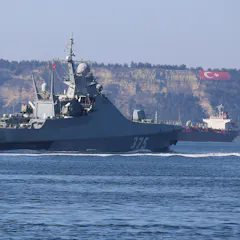
The Montreux Convention Regarding the Regime of the Straits gives Turkey control over the water route between the Black Sea and the Mediterranean.

Shipping requires vast amounts of fuel, and the questions of which country is responsible for emissions makes reaching agreements a mammoth and glacial task.
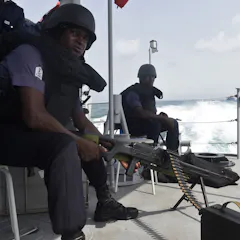
For the Deep Blue Project to work the government must address the factors that enable piracy and insecurity in the Gulf of Guinea.

Maritime salvage experts will use a variety of techniques to free the Ever Given from the Suez Canal.
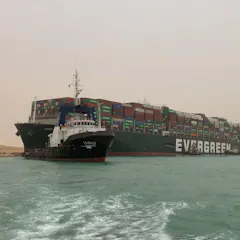
The Suez Canal is the ideal target for causing maximum disruption to global trade.
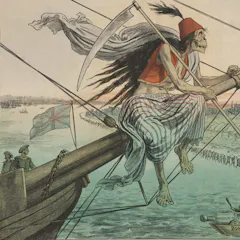
Some 1,500 years ago, the Plague of Justinian spread via ships from North Africa to Europe and Asia, killing up to 50 million people.
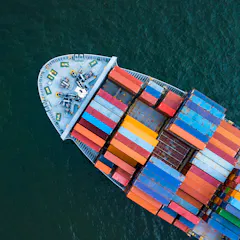
In three decades Australia’s merchant fleet has declined from about 100 ships to 14. It’s mostly to do with ships changing flags to avoid local laws and crews.
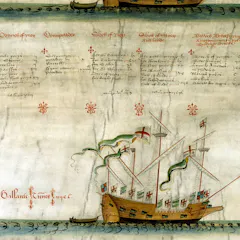
The cargo ship was built at around the time that England was beginning to look further afield for trade opportunities.
Top contributors
-

Maritime Logistics Expert, Centre for Supply Chain and Logistics (CSCL), Deakin University
-
Dean of Jimmy and Rosalynn Carter School for Peace and Conflict Resolution, George Mason University
-
Associate professor, University of Bristol
-
Professor of Political Science, University of Tennessee
-
Associate Professor in Cyber Security, University of Plymouth
-
Professor of Political Science, University of Nigeria
-
Distinguished Professor of History and Strategic Studies, University of Lagos
-
SEACAMS R&D Project Manager, Centre for Applied Marine Sciences, Bangor University
-
Professor, History, Dean of Arts, Australian Catholic University
-
Distinguished Professor of Political Science, Utah State University
-
Professor of Maritime Fluid Dynamics, University of Southampton
-
Industrial Researcher, University of Plymouth
-
Executive Dean, Faculty of Science and Engineering, University of Plymouth
-
Director, La Trobe Centre for Global Security, and Professor of International Relations, La Trobe University
-
Eugene M. Isenberg Chair in Integrative Studies, UMass Amherst