
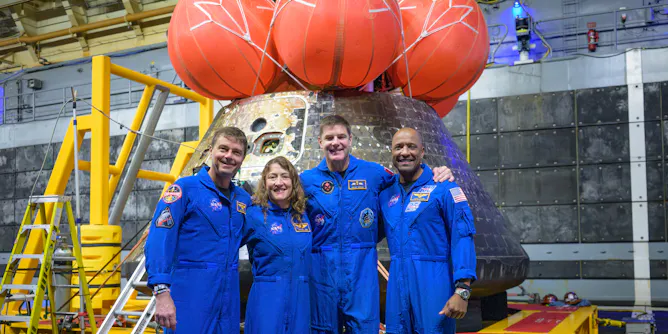
Jenni Gibbons will be lead capsule communicator for NASA’s Artemis III mission, Gordon Osinski is on the science team and Canada also contributes a robotic Lunar Utility Vehicle.
Articles on Lunar missions
Displaying all articles
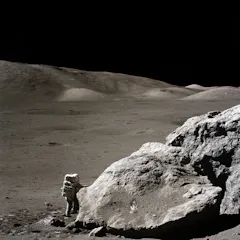
As lunar missions are back in vogue with engineering more sustainable human presence on the Moon in mind, there’s no getting away from the fact that you can’t breathe on a satellite that has no atmosphere.
Japan is one of several countries that weren’t part of the space race of the 1950s and 1960s looking toward the Moon. They’ve now become the 5th country to have landed on its surface.
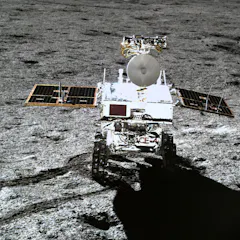
China has made significant advances in space exploration on its own steam. It doesn’t need a partnership with Russia.
Top contributors
-

Professor of Astrophysics, Macquarie University
-
Professor in Earth and Planetary Science, Western University
-
Associate Professor of International Affairs, Georgia Institute of Technology
-
Doctorant en sciences de l'ingénieur, Centre national de la recherche scientifique (CNRS); Université de Perpignan Via Domitia
-
Chargé de recherche, Centre national de la recherche scientifique (CNRS)
-
Directeur de Recherche, Centre national de la recherche scientifique (CNRS)
-
Chargé de projet vaisseaux spatiaux, Centre national d’études spatiales (CNES)